Why we use PVD, not plating.
Both methods put a colour layer on a piece of jewelry. They fail differently, cost differently, and support very different promises on a product page — and most buyers only learn the difference after a customer complains.
Published 2026-10-23 · KUBO Jewelry, Guangzhou
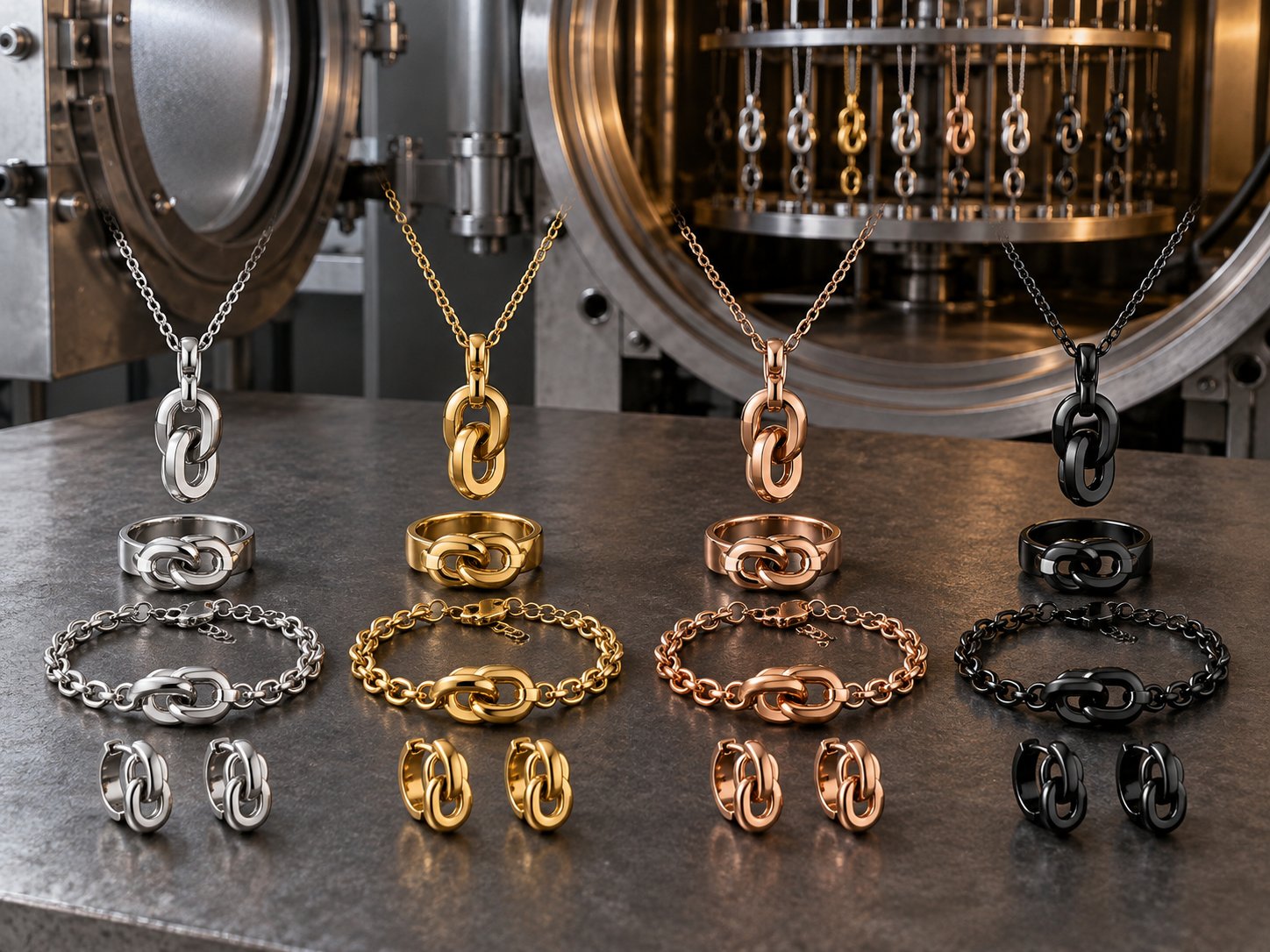
PVD (physical vapour deposition) bonds the colour layer into the stainless steel surface inside a vacuum chamber, so it resists abrasion, sweat and corrosion far longer than electroplating, which deposits a softer metal layer on top of the surface. KUBO Jewelry coats all production by PVD and does not run an electroplating line, because a plated layer eventually wears through and marks skin with the metal underneath. PVD does not make a piece indestructible, but it is the finish that makes a waterproof or tarnish-resistant claim defensible.
"Gold-plated" appears on jewelry from $5 keyrings to $500 necklaces. The phrase hides two completely different technologies — electroplating and PVD — and the difference decides how your product looks after three months of real wear, not after one photoshoot.
We are not neutral on this one: every piece we produce is coated by PVD, and we do not run an electroplating line. This article explains what that choice buys you and what it costs, because you will meet suppliers who offer both and you should be able to compare them.
How the two methods actually work
Electroplating is chemistry. Parts are immersed in a bath of metal salts; an electric current deposits metal ions onto the surface, layer by layer. Gold, silver, rhodium, nickel and copper layers build up in sequence, often starting with a copper or nickel "strike" coat. Thickness is measured in microns and controlled by time and current. The finished layer sits on the surface.
PVD (physical vapour deposition) is physics. Parts are loaded into a vacuum chamber; a target metal — usually titanium for coloured finishes — is vaporised by arc or sputter, and the vapour bonds into the surface while a reactive gas (nitrogen, acetylene) forms a ceramic compound in the same pass. The result is a titanium-nitride-family layer a fraction of the thickness of plating, but it is grown into the surface rather than stacked on it.
That one sentence is the whole technical difference, and everything below follows from it.
Why that matters on skin
The failure modes are completely different.
A plated layer wears the way paint wears. Thin spots appear where the piece rubs, and once the layer is breached, the base metal is exposed. Over brass that means dark copper stains migrating through the remaining plating; over zinc, white oxide. Over stainless steel there is comparatively little visible damage, because the base does not corrode — but the colour is gone, and the piece looks worn.
Sweat accelerates both processes, which is why plated jewelry fails fastest in exactly the situations people wear it — a ring under a gym glove, a chain against the neck in summer.
A PVD layer is a dense ceramic compound bonded into the steel. It resists the two things that kill plated finishes fastest: abrasion from clothing and skin contact, and sweat chemistry working on an exposed metal layer. Because there is no soft metal deposit sitting on the surface, there is nothing for salt and acid to eat into.
The comparison that matters
| Property | PVD | Electroplating |
|---|---|---|
| Layer bonding | grown into surface | deposited on surface |
| Typical thickness | ~0.2–1 µm, very dense | 0.5–20+ µm depending on spec |
| Wear resistance (abrasion) | very high | moderate |
| Sweat / corrosion resistance | high over stainless steel | depends on base metal and thickness |
| Colour range | steel, gold tones, rose gold, black, bronze | any metal colour, incl. bright silver/rhodium |
| Mirror brightness | satin to semi-gloss | full mirror possible |
| Colour consistency between batches | high (process-controlled) | bath-dependent, needs QC |
| Batch cost at jewelry volume | higher | lower |
| Typical use | everyday wear, chains, rings, watch hardware | fashion jewelry, bright silver looks, low-price lines |
What PVD lets us promise
This is the practical reason we made the choice, and it is the part that affects your product page.
When a buyer asks whether a piece can be sold as waterproof, sweat-proof or tarnish-resistant, the honest answer depends entirely on the finish. Over 316L stainless steel with PVD, those claims hold up in ordinary use — including swimming, showering and sport. On the same steel with conventional plating, they do not, and a brand that makes them anyway ends up absorbing returns.
We will not put a number of months or cycles on it, because coating life depends on how the piece is worn — a bangle knocked against a desk edge every day is not the same wear as a pendant. What we control is the specification: base alloy, surface preparation, coating process and thickness, and we put those four in writing on every quote.
Where PVD is the weaker choice
Being straight about the limits is more useful than pretending they do not exist:
Bright silver and rhodium-white looks. PVD does not produce a mirror-bright rhodium finish. If your line's identity depends on that chrome-like shine, electroplating is the route — and a supplier who tells you PVD will match it is either misinformed or hoping you will not compare.
Cost per batch, at low volume. PVD runs in vacuum chambers with cycles measured in hours, so chamber time is the cost driver. At small quantities the per-piece share of a chamber load is higher than a quick plating run would be. That cost is what buys the durability, and at commercial volume it flattens out considerably.
Colour depth. Gold-tone PVD reads slightly deeper and less mirror-bright than electroplated gold — closer to brushed fine jewelry than to costume shine. Most of our buyers selling waterproof jewelry see that as the correct look; some brands want the shine instead, and that is a legitimate answer.
What we do not do
We do not run an electroplating line, so we will not quote a plated piece. When a design genuinely needs a bright mirror or a silver look, we say so at the brief stage rather than take the order and subcontract the finish to someone whose quality we cannot control.
That is a narrower service than a factory claiming every process. It also means the finish on your sample is the finish on your production run, made in the same chamber, to the same specification.
Two rules we apply to every project
- Match the finish to the claim you want to make. If the product page will say waterproof, tarnish-free or sweat-proof, the finish should be PVD over 316L — and that claim should come from the finish, not from marketing.
- Never let coating substitute for polish. A coating over a poor polish looks fine in the box and fails fast on skin. Surface preparation before coating matters more than the coating itself.
Next step
Have a project this applies to?
Keep reading
More buyer guides
Stainless steel vs brass vs zinc alloy for jewelry
The three metals behind most mass-market jewelry lines, compared on what actually matters — cost behaviour, weight, allergy risk and how long a colour survives.
Launching a first stainless steel jewelry collection
What to develop first, what to defer, and how to keep the first order affordable.
304 vs 316L stainless steel for jewelry
Which grade to specify, what it costs you, and when the cheaper one is the right answer.