Steel, brass or zinc alloy?
Most jewelry lines are made from one of these three metals, and the choice quietly determines your unit cost curve, your weight claims, your allergy exposure and how long the colour survives.
Published 2026-10-20 · KUBO Jewelry, Guangzhou
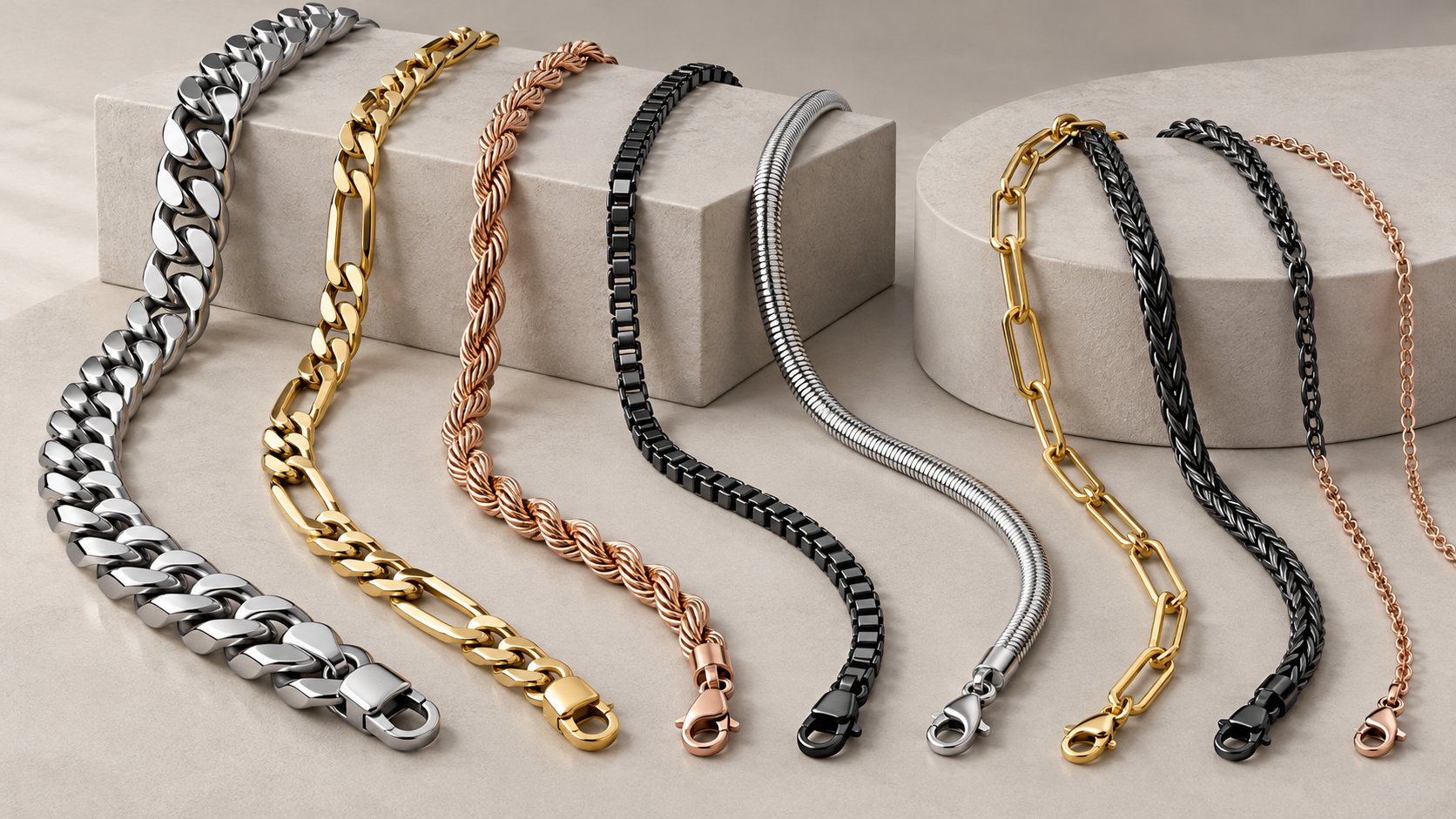
Stainless steel is the strongest and most allergy-stable of the three, holds plating longest because it does not corrode underneath, and stays cheap at volume. Brass is heavier with a warmer colour and machines beautifully, but corrodes under plating and can trigger nickel and copper complaints. Zinc alloy is the cheapest and easiest to cast into complex shapes, but it is the softest, the least durable, and the hardest to sell as a premium material.
Ask a supplier what a piece is made of and you will usually get one word: "alloy". That word covers all three of the metals in this article, and they behave nothing like each other in production. If you are building a brand, the metal is not a detail — it decides what you can charge in three years and what your return rate looks like in six months.
The one-paragraph version
Stainless steel is an iron-chromium alloy that protects itself with a passive oxide layer. Brass is copper and zinc, valued for its warm colour and machining quality. Zinc alloy is zinc with aluminium, magnesium and copper, valued because it melts at a low temperature and fills complex moulds cheaply.
Steel is the hardest and the most corrosion-stable. Brass is the craftsperson's metal. Zinc alloy is the accountant's metal. All three are usually colour-coated, which is where most of the confusion starts — because the coating hides which metal you are actually getting.
Side-by-side specification
| Property | Stainless steel (304/316L) | Brass | Zinc alloy |
|---|---|---|---|
| Hardness / scratch resistance | high | medium | low |
| Density (wears "heavy") | 7.9 g/cm³ | 8.5 g/cm³ | 6.6 g/cm³ |
| Corrosion under coating | none (passive layer) | yes — copper oxide | yes — white oxide |
| Base colour | grey-white | warm yellow | grey |
| Casting detail | moderate (die-cast or cut) | excellent (machined or cast) | excellent (die-cast) |
| Nickel risk | nickel-bearing, controlled release | often nickel-plated; copper issues | alloy composition varies by supplier |
| Coating adhesion | excellent on polished surface | good, but base can stain through | good initially, weakest long-term |
| Relative unit cost at volume | low | medium–high | lowest |
| Best use | everyday wear, chains, rings | premium lines, warm-tone designs | cheap promotional pieces, complex shapes |
Density is worth a comment: brass actually weighs more than steel, so "heavy = quality" is not reliable. A zinc alloy pendant loaded with a thick coating layer can feel similar to a steel one in the hand. Weight claims should come from the spec sheet, not the palm test.
Where each metal wins
Stainless steel wins on everything a customer does to the piece after purchase. It does not corrode under the coating, so a scratch that exposes base metal still looks like metal rather than a green or black stain. It survives sweat, shower, gym and beach better than the alternatives. For everyday-wear positioning — and that is where most stainless steel jewelry brands live — it is the only one of the three that supports a "made to be worn constantly" story honestly.
Brass wins on design intent. It machines into crisp geometry, solders cleanly, and its warm undertone makes gold plating look richer — a gold-plated brass piece genuinely looks more like fine jewelry than the same design in steel. The cost is maintenance of the claim: brass oxidises, so any break in the coating shows as a dark copper stain, and copper ions are a common cause of green-skin complaints. Brass lines need tighter QC on coating thickness.
Zinc alloy wins on complexity and price. It casts at low temperature into moulds with fine detail — that is why so many promotional pieces, badge-style pendants and fashion shapes are zinc. It is also the cheapest route to a three-dimensional form. What it cannot support is durability positioning. It is soft; threads, posts and clasps wear out; and plating over zinc fails earlier than over steel because the base corrodes once moisture reaches it. If your business model is high-turnover fashion at a low price point, zinc is a rational choice. Just do not build a brand promise of longevity on it.
The coating question nobody asks early enough
Colour life is mostly decided by the metal underneath, not the coating itself. Electroplated layers are thin — microns, not fractions of a millimetre — and they fail from the base up. When the base is a passive alloy like stainless steel, a breached coating still leaves a wearable surface. When the base is brass or zinc, the same breach starts an oxidation stain that migrates back through the coating layer and shows as discolouration.
This is the single biggest reason stainless steel jewelry has taken share from plated fashion jewelry in the last decade. It is not that the coating is better. It is that failure looks less dramatic when it happens.
The allergy and compliance picture
- Stainless steel contains nickel (8–14% depending on grade) but releases it slowly through the passive layer. EU nickel-release compliance is routinely achievable with 316L and good polishing; test by EN 1811.
- Brass contains no nickel as a base alloy, but copper release causes its own skin reactions, and brass findings are frequently nickel-plated for brightness — which reintroduces the nickel question through a layer that wears.
- Zinc alloy composition varies most between suppliers, and some grades contain lead or cadmium above the limits that EU REACH entry 23 and similar rules set for jewelry. If you buy zinc, you need a composition report from the actual supplier, not a category assumption.
One honest caveat from our side: we produce in stainless steel, and we do not hold standing REACH or nickel-release certificates — mill certificates for every steel lot we supply, yes; standing claims, no. Third-party testing is arranged per order with an accredited laboratory. The same logic applies to whichever metal and whichever factory you choose: ask what document backs the metal, not what the product page says.
How buyers actually decide
In practice, the decision tree is short:
- Is the piece worn against skin daily, or marketed as durable? Stainless steel, 316L for posts and rings.
- Is the design's value in warm colour and machining detail, sold at a premium? Brass, with a coating-thickness spec you enforce.
- Is the piece a low-price, high-turnover fashion or promotional item with a short intended life? Zinc alloy, with a supplier composition report.
Most brands that come to us have a range, not a single piece — and the practical answer is often a mix: 316L for everything worn against skin, and a cheaper construction for components and gift-with-purchase items. The mistake is not choosing one of the three. It is choosing one of the three without knowing you chose it, because the quote just said "alloy".
Next step
Have a project this applies to?
Keep reading
More buyer guides
Launching a first stainless steel jewelry collection
What to develop first, what to defer, and how to keep the first order affordable.
304 vs 316L stainless steel for jewelry
Which grade to specify, what it costs you, and when the cheaper one is the right answer.
What MOQ really means for custom jewelry
Why there is no single number, what drives it, and how to negotiate it sensibly.