Custom development
Custom stainless steel earrings.
Hoops, studs, drops and huggies. Worn against the skin, worn daily, and returned most often — which makes material grade and post construction the decisions that matter.
Reviewed 19 October 2026 · KUBO Jewelry, Guangzhou
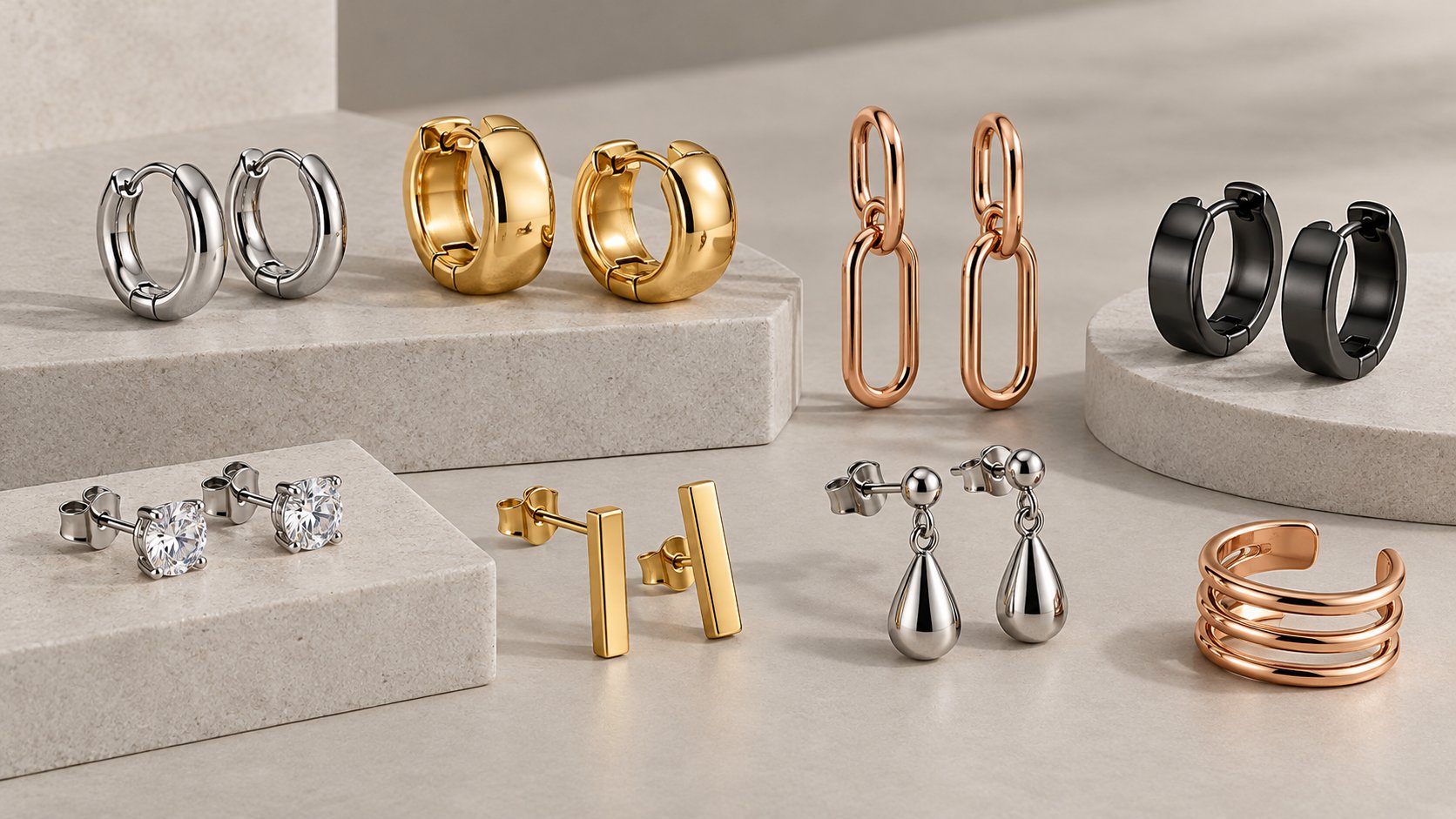
KUBO Jewelry produces custom stainless steel earrings — hoops, studs, drop earrings, huggies and ear cuffs — in 304 or 316L stainless steel, with hoop diameters from 8 mm to 70 mm, post or clip fittings, PVD colour coating and laser engraving.
Earrings are the highest-return category in fashion jewelry, and almost all of those returns trace back to two things: the metal touching the ear, and the fitting. Both are decisions made at specification, not at packing.
The post is the whole product
A hoop can be beautiful and still fail on a 0.7 mm post that bends on the second wear, or on a butterfly back that loses tension after a month. Three specifications matter:
Post diameter. 0.8 mm is standard; 1.0 mm is more durable and increasingly expected on premium pieces. Below 0.7 mm, the post deforms in normal use.
Post material. Use 316L for the post even when the body is 304. The post is what sits in a healing or sensitive piercing, and it is where a nickel reaction will actually occur.
Back type. Butterfly backs are cheapest and the most common source of complaints. Screw backs and flat-backs cost more but reduce loss and returns, which matters more than the unit cost difference at retail price points.
Why 316L for earrings
316L contains 2–3% molybdenum, which improves resistance to chlorides — sweat, in practice. 304 does not, and in prolonged skin contact with perspiration it can pit and discolour. For a piece sold as "hypoallergenic" or "sensitive skin friendly", 316L is the defensible material choice. If you make that claim, understand that the material is only half of it: the claim is about nickel release from the finished piece, and the evidence for it is a test report rather than the grade name on an invoice. Neither grade is nickel-free. If you make a sensitivity claim with no test behind it, that is a consumer-protection exposure in both the EU and the US.
Hoop diameters and market fit
Hoop size is highly market-specific. US, UK and Australian buyers have moved toward larger diameters — 40 mm to 70 mm — while German, Dutch and Nordic buyers favour 12–25 mm. Gulf markets tend toward the larger end, often with more elaborate surface treatment. Huggies in the 8–12 mm range have stayed consistently strong as a volume product because they suit multiple piercings and photograph well as a set.
If you are launching a first earring range, huggies and small studs carry the lowest material and tooling exposure and the fastest path to a sellable set. Large hoops need proportion and weight balanced carefully — a 60 mm hoop in the wrong wall thickness reads as cheap immediately.
Manufacturing notes
Twisted and hammered hoops are popular but need the pattern applied consistently around the full circumference; inconsistency is invisible in a front-on photograph and obvious in the hand. On drop earrings, the connection between the ear wire and the drop is the weak point, and we specify it against the finished weight rather than by habit.
| Specification | Options |
|---|---|
| Types | Hoops, studs, drops, huggies, ear cuffs, threaders |
| Material | 304 or 316L stainless steel |
| Hoop diameter | 8 mm to 70 mm |
| Post | 316L post, 0.8 or 1.0 mm, butterfly or screw back |
| Surface | Mirror, brushed, satin, hammered, twisted |
| Colour | Steel, gold, rose gold, black, gunmetal |
| Logo | Laser engraving on post disc or inner hoop |
For earrings sold in the EU, confirm nickel release testing at the brief stage. The test is run by an accredited third-party laboratory rather than in-house, and it is far cheaper to arrange before production than after.
 {{#if wide_caption}}
Other categories
Continue exploring
The same tooling, finishing and QC apply across every category. Most collections combine two or three.
Rings
Bands, signet rings, stacking rings and statement pieces in 304 or 316L stainless steel.
Necklaces & pendants
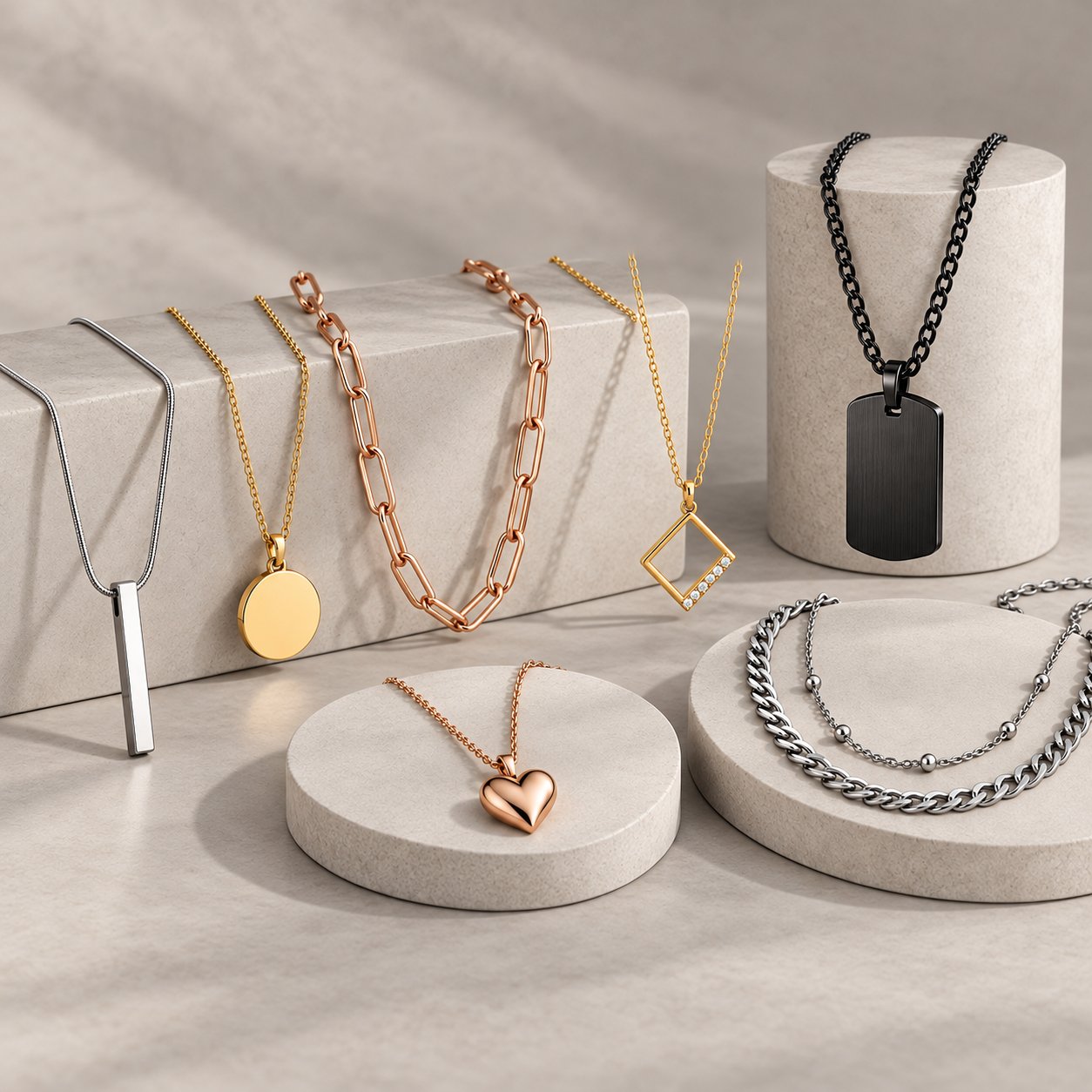
Chains, pendants, chokers and layered sets — matched so the chain and pendant arrive as one product.
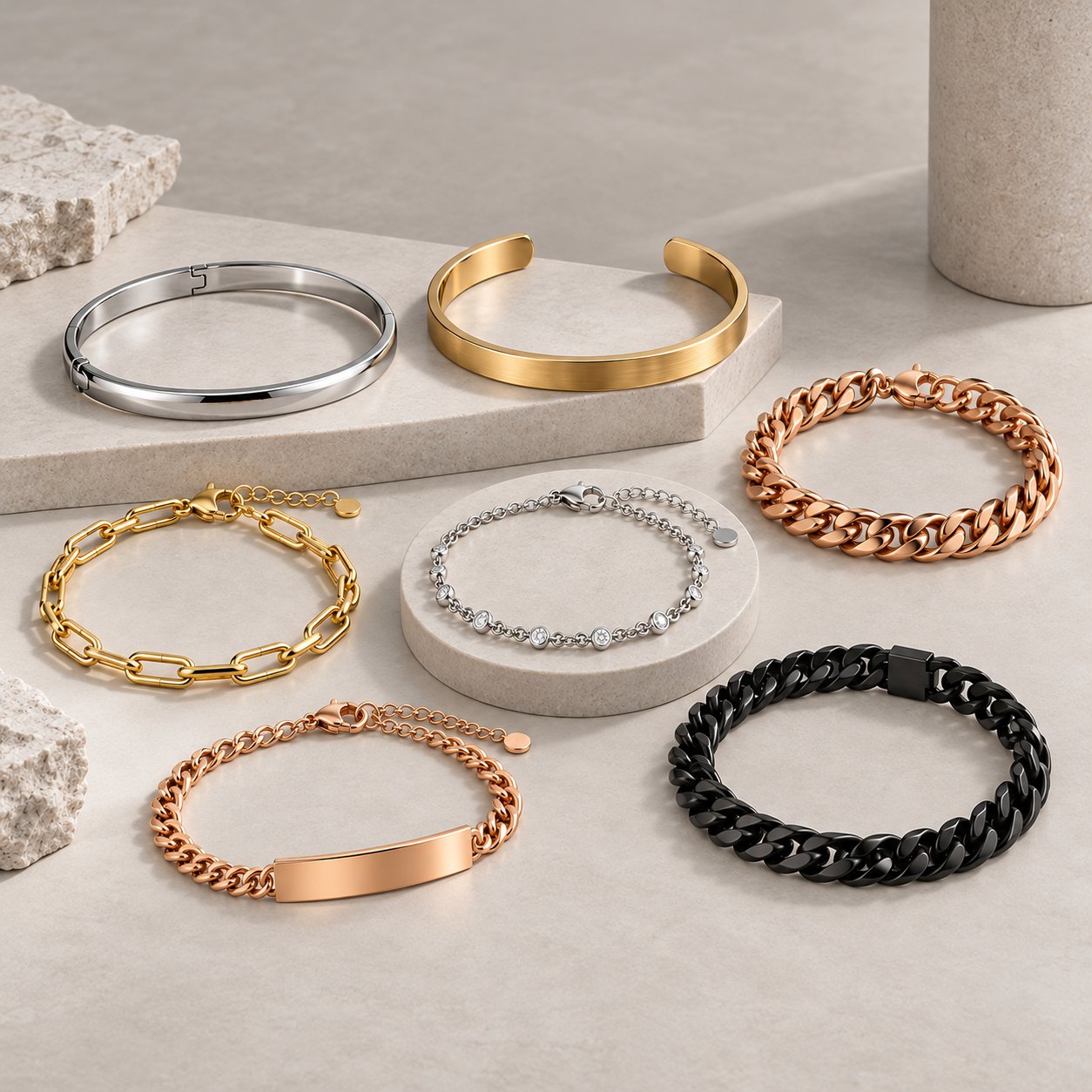
Bracelets & bangles
Chain bracelets, cuffs, bangles and tennis styles — sized for wrists, weighed for presence.
Developing a new range?
Tell us the specification.
Send a drawing, a reference product or a written brief. We will reply with feasibility, a proposed sample timeline and the questions that matter for your price point.
Request a quotation →