Custom development
Custom stainless steel fashion hardware.
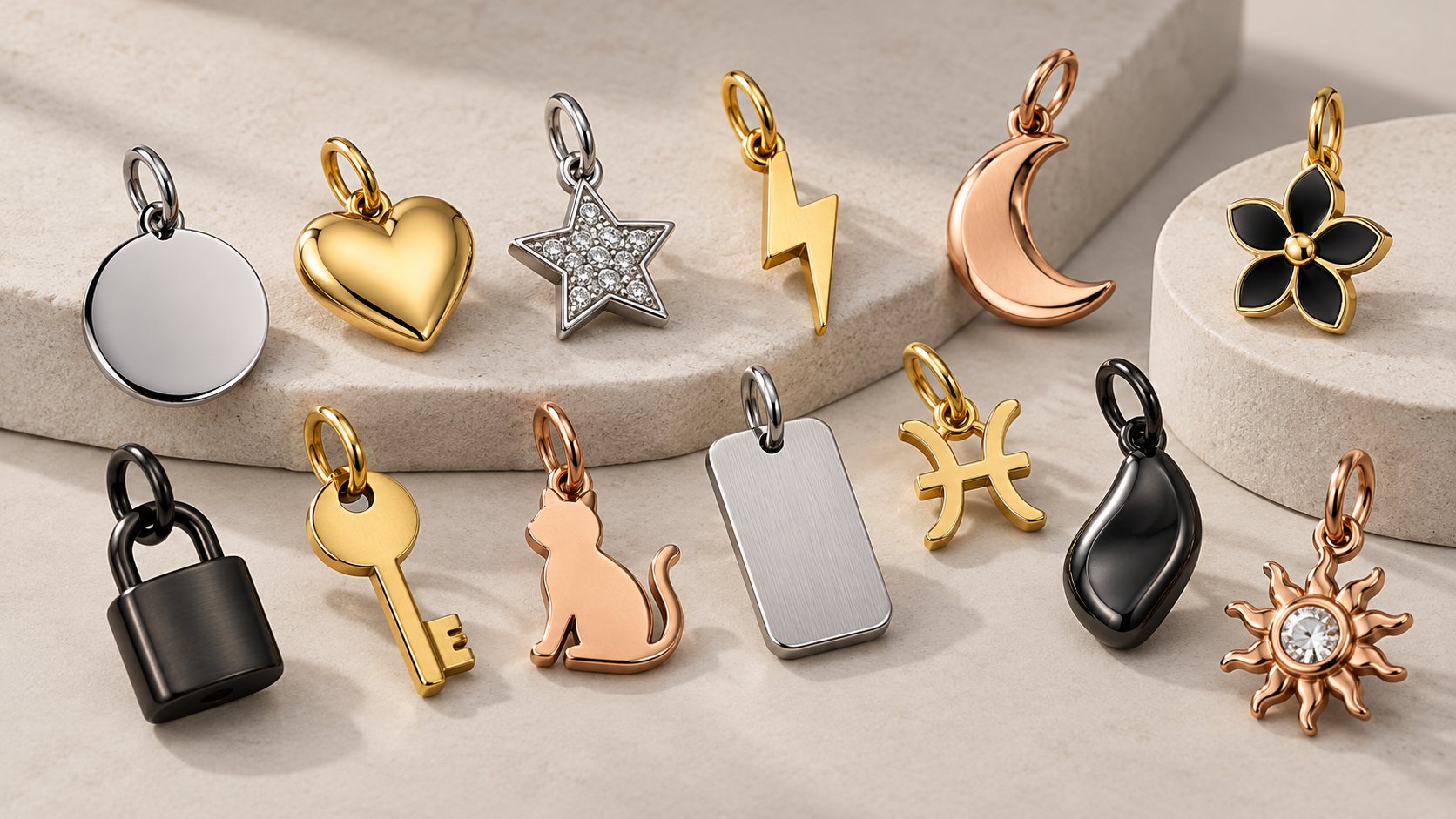
The parts that carry a brand on a garment or a bag: logo tags, zipper pulls, bag charms, D-rings and connectors. Produced on the same tooling base and finishing line as the jewelry — which is why the colour matches.
Reviewed 19 October 2026 · KUBO Jewelry, Guangzhou
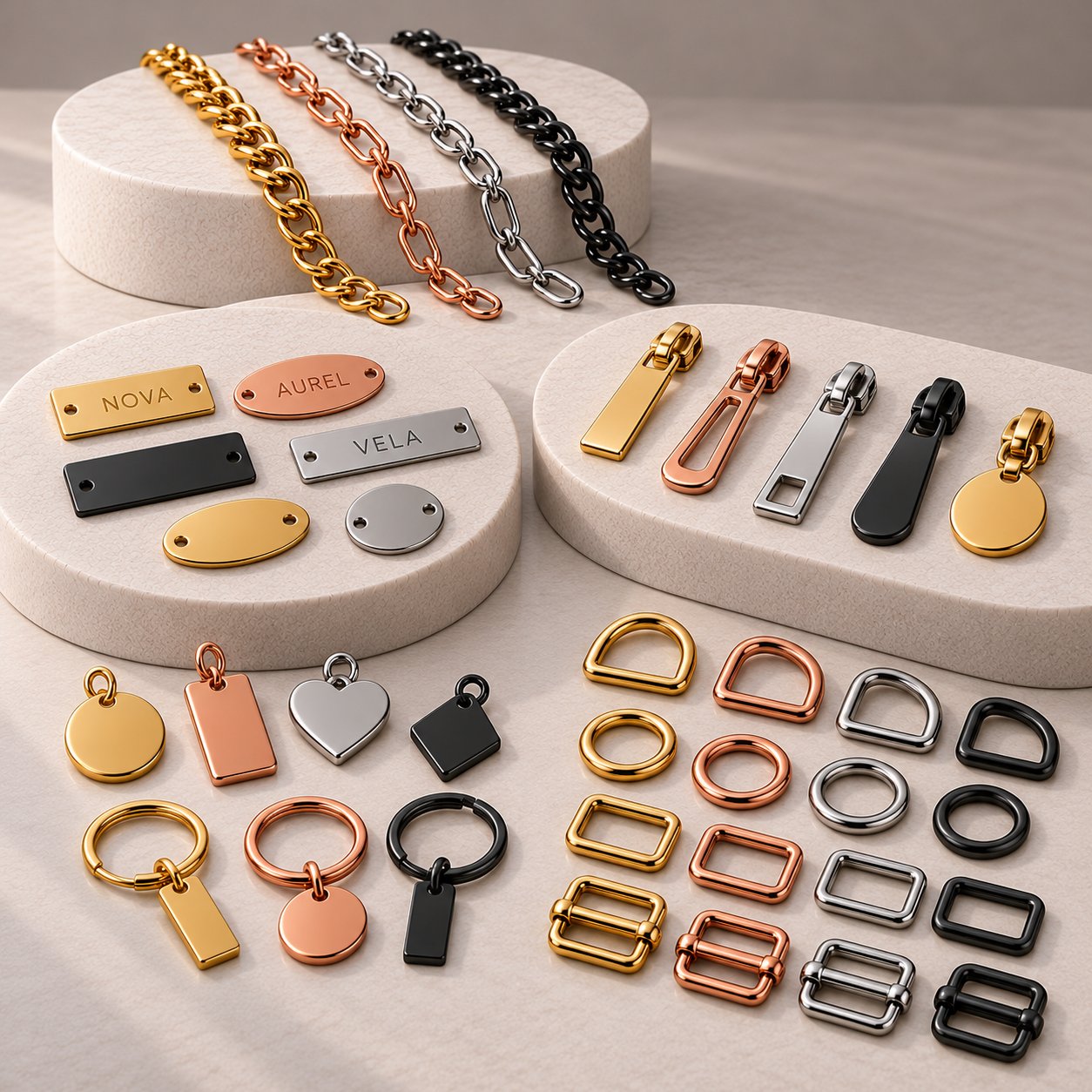
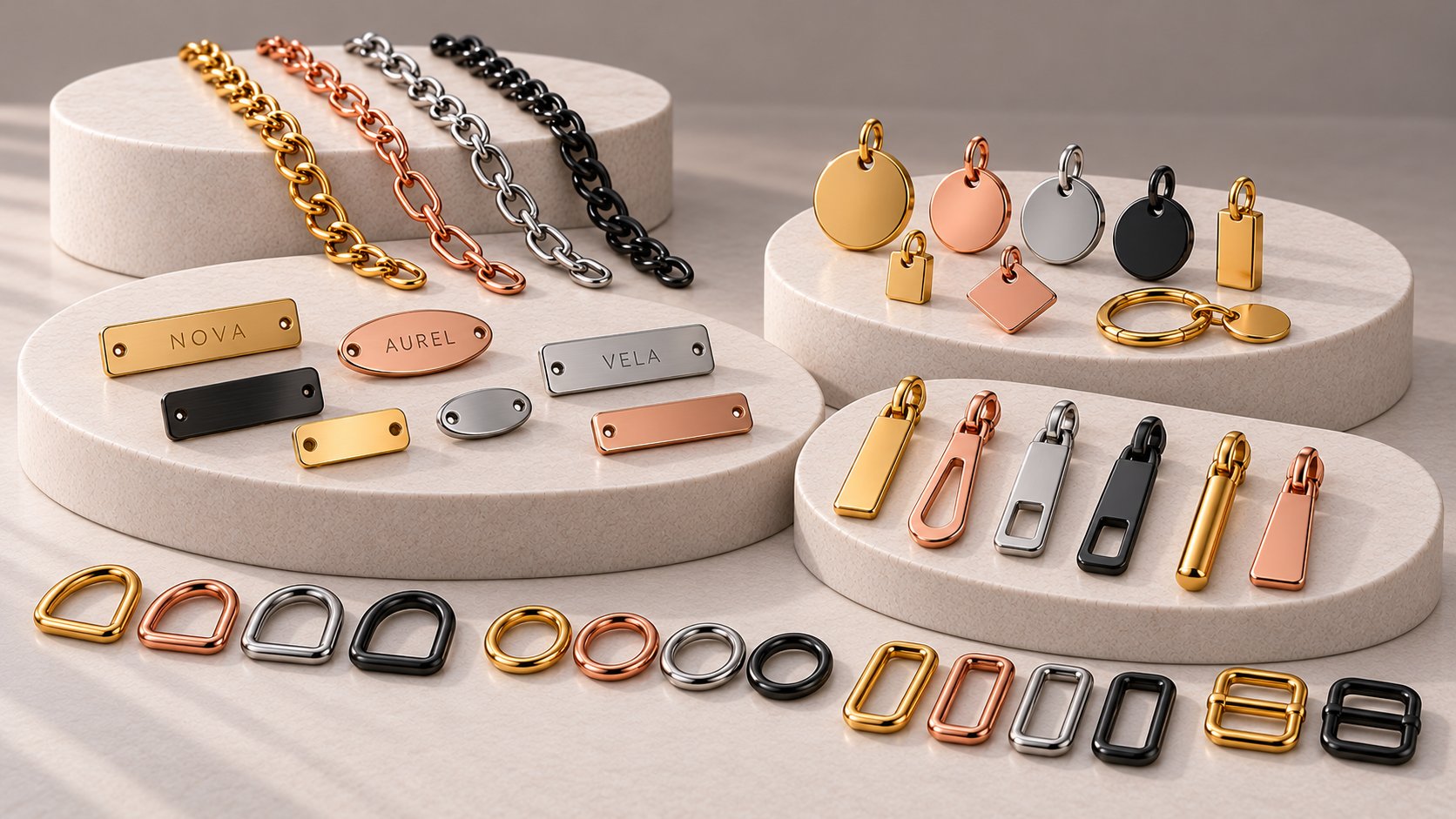
KUBO Jewelry produces custom stainless steel fashion hardware for apparel, bags and accessories — engraved metal logo tags and plates, zipper pulls, bag charms and decorative chains, and rings and connectors including D-rings, rectangular rings, buckles and keyrings. All are made in 304 or 316L stainless steel with laser engraving, chemical etching, stamping or enamel fill, and PVD colour finishes in steel, gold, rose gold, black and gunmetal.
Jewelry and bag hardware are the same problem seen from two directions. A pendant hangs from a chain and carries its own weight; a zipper pull hangs from a slider and gets pulled thousands of times; a logo plate is sewn to a bag panel and has to survive the panel, not just the wearer.
We make these parts on the same tooling base and the same PVD line as the jewelry. That is the practical argument for buying them here rather than from a separate hardware trader: a brand that puts a gold charm on a bag and a gold tag on the strap gets two parts in the same colour, from the same batch chemistry.
The four product groups
Metal logo tags and plates. Flat or domed plates carrying a brand mark, usually with two or four holes for stitching, or a rivet or screw fixing. Thickness is the variable buyers underestimate: below 0.8 mm the plate distorts under a rivet and reads as foil rather than metal; above about 2.0 mm it stops sitting flat on a seam and needs a backing. Edge treatment matters as much as the face — a sharp die-cut edge catches thread and wears through lining fabric, so edges are broken and polished on anything that will touch textile.
Zipper pulls. The pull has to fit the slider it is sold with, and sliders are specified by gauge (#3, #5, #8 and so on). A pull that fits a #5 slider will not fit a #3, and the difference is a millimetre or two that no product photo shows. We ask for the slider reference or a physical sample before quoting, because the connector — not the decoration — is where these fail. Decorative pulls are supplied as a separate part to be fitted to an existing slider, or as a complete pull-and-slider assembly where the zipper supplier is known.
Bag charms and decorative chains. The same chain geometries as the jewelry range — curb, cable, box, rope — with a swivel hook or a split ring at one end. Two specifications decide whether it survives: the chain gauge relative to the weight of the charm, and whether the connector is a swivel. A fixed ring on a heavy charm twists the links against each other every time the bag is set down; a swivel lets the charm hang and roughly doubles the life of the assembly.
Rings and connectors. D-rings, rectangular rings, O-rings, buckles and keyrings. These are load-bearing parts, and the load is carried by the joint, not the section: a welded D-ring and an unwelded one look identical and behave nothing alike. We specify welded or brazed joints for anything load-bearing, and we will tell you the working limit we would stand behind rather than quote a number we cannot test.
Marking methods, and what each one costs you
| Method | Look | Tooling | Best for |
|---|---|---|---|
| Laser engraving | Fine, precise, shallow; darker than the base metal on steel | none | Logos with fine type, small tags, low minimums |
| Chemical etching | Recessed, crisp, can be filled with enamel or ink | photoresist tool per design | Detailed marks, blackened recesses, mid volumes |
| Stamping / embossing | Raised or debossed metal, tactile | steel die per design | Bold marks, hardware that should feel solid |
| Enamel fill | Colour in a recess, glassy surface | resist tool plus colour work | Brand colours, contrast on gold or black |
Two honest notes. Engraving depth is not unlimited on thin plate — a 0.8 mm tag engraved too deep cups and loses flatness, so fine line work on thin tags is shallow by necessity. Enamel colour is matched by eye against an approved sample, not by Pantone reference; pigments do not carry a universal colour standard, and the approved physical sample is the standard for the run.
Where hardware buyers get caught
Colour drift between jewelry and hardware. This is the single most common complaint, and it happens when the two parts are bought from different suppliers whose "gold" is a different gold. Buying both from the same finishing line is the fix; a colour sample approved across both product families is the discipline that keeps it fixed on reorders.
Nickel release on skin-contact parts. Most hardware never touches skin, but bag charms, keyrings and zipper pulls on inner pockets do. If a part will be handled repeatedly, specify 316L and treat it like jewelry for compliance purposes. We do not hold standing test certificates — mill certificates for every steel lot, yes; nickel-release and REACH testing arranged per order with an accredited third party, quoted as a separate line.
Sharp edges against textile. A hardware part is judged by the bag it damages. Every edge that can contact fabric is broken and polished; if a design cannot be de-burred without losing its shape, we will say so before tooling rather than after.
Hole position versus seam allowance. Sew holes are specified to the stitch line, not to the plate. A 2 mm error in hole spacing is invisible on the drawing and fatal on the production line, which is why we ask for the finished panel or a dimensioned marker rather than a logo file alone.
Specifying a hardware range
The brief that gets a useful quote, in this order:
- Part type and function — decorative or load-bearing, and what it attaches to.
- Material and thickness — 304 for cost, 316L where skin contact or corrosion matters; thickness per part type.
- Marking method and artwork — vector file, and whether the mark is engraved, etched, stamped or filled.
- Finish and colour — and whether it must match an existing jewelry or bag range. Send the reference.
- Attachment — sew, rivet, screw, split ring or swivel, with the slider or strap it interfaces with.
- Quantity per colour and per design — hardware orders are usually split across colours, which affects the minimum.
Send those six things and the quote comes back specific. Send a logo and the word "gold" and it comes back as a range, not a price — which is the point at which most hardware projects lose a month.
| Specification | Options |
|---|---|
| Product groups | Logo tags and plates, zipper pulls, bag charms and decorative chains, rings and connectors |
| Material | 304 or 316L stainless steel |
| Tag thickness | 0.8 mm to 2.0 mm |
| Marking | Laser engraving, chemical etching, stamping and embossing, enamel fill |
| Attachment | Sew holes, rivet, screw post, split ring, swivel hook |
| Rings and connectors | D-rings, rectangular rings, O-rings, buckles, keyrings |
| Surface | Mirror, brushed, satin, sandblast |
| Colour | Steel, gold, rose gold, black, gunmetal |
Hardware minimums are driven by the marking method rather than the metal. Laser engraving has no tooling and the lowest minimum; chemical etching needs a photoresist tool, and stamping or embossing needs a die — both of which set a floor. Tell us the intended marking and we will quote the minimum that fits it.
 {{#if wide_caption}}
Other categories
Continue exploring
The same tooling, finishing and QC apply across every category. Most collections combine two or three.
Rings
Bands, signet rings, stacking rings and statement pieces in 304 or 316L stainless steel.
Necklaces & pendants
Chains, pendants, chokers and layered sets — matched so the chain and pendant arrive as one product.
Earrings
Hoops, studs, drops and huggies — the category where metal grade and post quality matter most.
Developing a new range?
Tell us the specification.
Send a drawing, a reference product or a written brief. We will reply with feasibility, a proposed sample timeline and the questions that matter for your price point.
Request a quotation →