Your first collection.
A first order has to do two jobs at once: prove the supplier and produce something that sells. Most first orders try to do too much and achieve neither.
Published 2026-04-08 · KUBO Jewelry, Guangzhou
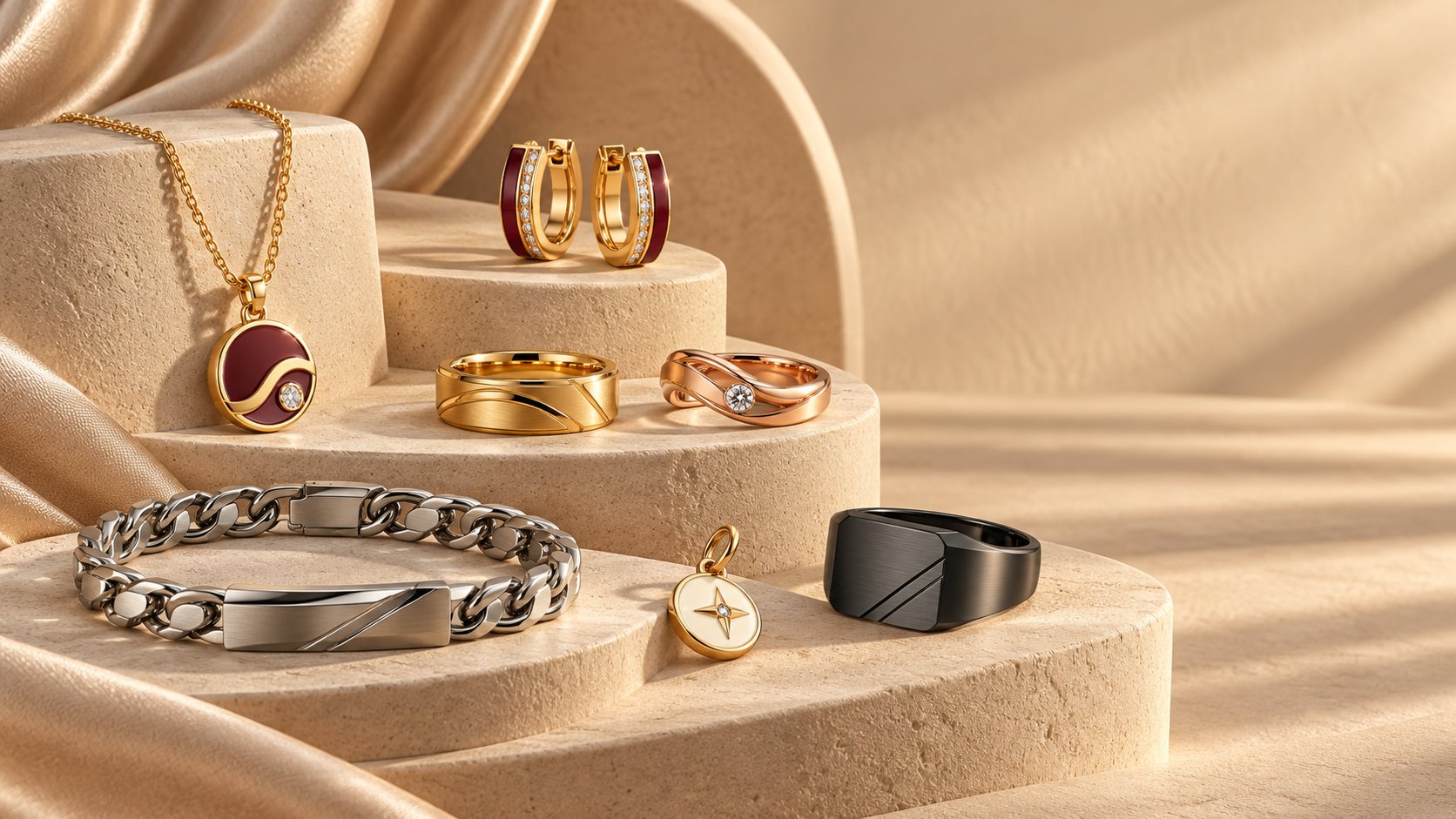 {{#if image_caption}}
A first stainless steel jewelry collection should start with two or three low-tooling categories such as charms, earrings or simple bands, in one finish and a narrow size range, at a quantity that proves the supplier before a larger commitment. Defer cast pieces, multiple colours and custom packaging to the second order.
The most common mistake in a first collection is scope. Fifteen designs, four colours, three chain types, custom boxes. It arrives late, costs more than planned, and by the time it lands the buyer has no budget left to test what actually sells.
Start with low-tooling categories
Tooling is the cost you cannot recover. Avoiding it in the first order is the single biggest lever you have.
| Category | Tooling exposure | Notes |
|---|---|---|
| Charms (laser-cut) | Very low | Fastest sample cycle, best first choice |
| Simple bands | Low | Standard sections, minimal tooling |
| Huggies and small studs | Low | High repeat purchase |
| Chain bracelets | Moderate | Depends on clasp and finding |
| Cast pendants | Higher | Mould required |
| Sculpted statement pieces | Highest | Multi-part moulds |
Two or three low-tooling categories, developed well, will teach you more than fifteen developed badly.
One finish, not four
Each colour is a separate plating run and a separate colour-matching problem. Launching in bare steel or a single PVD tone, then adding colours on the reorder, costs materially less and lets you test whether the design sells before you pay for the variants.
There is a commercial argument for launching with colour — a gold-tone piece photographs better and often converts better. Make that decision deliberately, not by default across every design.
A narrow size range
For rings, launching with three or four sizes rather than ten reduces the SKU count and the minimum commitment per size. Extend once the design proves itself. For bracelets, an adjustable or extender option covers more wrists with fewer SKUs.
Where to spend, and where not to
Spend on:
- Polish quality. It is visible in every photograph and every hand.
- Clasps and findings. The failure point, and the source of most returns.
- Material grade on skin-contact parts. Posts in 316L.
- Sample revision rounds. Two rounds of refinement on three designs beats one round on ten.
Do not spend on:
- Custom packaging in the first run. Brand it on the second order once you know what sells. Packaging minimums are usually higher than jewelry minimums.
- Multiple chain types. One reliable cable and one curb cover most needs.
- Complex internal engraving. A mark on the packaging is often enough for a first range.
Timeline, realistically
Working backwards from a launch date:
| Stage | Typical duration |
|---|---|
| Brief and specification | 1–2 weeks |
| Sampling | 10–15 days |
| Revision round | 7–10 days |
| Bulk production | 20–35 days |
| Shipping (express) | 3–7 days |
| Shipping (air freight) | 7–12 days |
That is roughly ten to twelve weeks from a settled brief to goods in hand, assuming no revision overruns. A launch date that does not allow for two revision rounds is a launch date that will slip.
What to tell your supplier
Three things make the biggest difference to how useful the first reply is:
- Your target retail price. This is the most useful single number a buyer can give. It determines which material, which finish and which construction are viable, and a supplier who knows it can tell you what will not work at that price rather than quoting something that cannot be built profitably.
- Your sales channel. E-commerce, wholesale to boutiques, and marketplace selling have different requirements for packaging, photography and compliance documentation.
- Your market. Compliance requirements differ by destination — nickel release testing and GPSR labelling for the EU, state-level packaging rules for the US, SASO for Saudi Arabia, and different duty treatment again for the UK, Canada and Australia. Note that these are not things a factory "has": the labels and test reports are normally arranged by you or your importer, with the factory supplying material documentation and samples. Budget for them in the launch plan rather than assuming they come with the goods.
The honest summary
A first order should be small enough that a mistake is survivable and large enough that a success is meaningful. Everything else is negotiable.
Next step
Have a project this applies to?
Keep reading
More buyer guides
304 vs 316L stainless steel for jewelry
Which grade to specify, what it costs you, and when the cheaper one is the right answer.
How to evaluate a stainless steel jewelry supplier
Ten questions that separate a manufacturer from a middleman, and the answers that should worry you.
What MOQ really means for custom jewelry
Why there is no single number, what drives it, and how to negotiate it sensibly.