304 vs 316L: which steel?
The choice affects allergy risk, salt-water performance, unit cost and what you are legally allowed to claim on the product page.
Published 2026-03-12 · KUBO Jewelry, Guangzhou
 {{#if image_caption}}
316L stainless steel contains 2–3% molybdenum, which gives it better resistance to chlorides such as sweat and salt water, making it the better choice for earrings, pieces worn against the skin, and products sold as hypoallergenic. 304 is cheaper and sufficient for charms, components, pendants and lower price points. Both are nickel-bearing alloys; neither is nickel-free.
Almost every stainless steel jewelry buyer asks this question, and most suppliers answer it with "316L is better". That is true and useless. The real question is which pieces in your range justify the extra cost.
The difference in one paragraph
Both are austenitic stainless steels. 316L adds 2–3% molybdenum, which specifically improves resistance to chlorides — salt, and in practice sweat. It also has a lower carbon content (the "L" stands for low carbon), which reduces sensitisation during welding and forming.
That is the entire technical difference. Everything else follows from it.
| Property | 304 | 316L |
|---|---|---|
| Chromium | 18–20% | 16–18% |
| Nickel | 8–10.5% | 10–14% |
| Molybdenum | none | 2–3% |
| Chloride resistance | moderate | good |
| Relative material cost | lower | higher |
| Skin contact suitability | acceptable | preferred |
| Typical use | components, charms, pendants | earrings, rings, bracelets |
Both grades are in regular production here, and both appear in most of the collections we make. The table above is a specification comparison, not a ranking of the two suppliers who sell them.
Where the difference actually shows
Sweat. A ring worn daily sits in perspiration for hours. 304 will develop dull spots and, over time, pitting at the contact points. 316L resists this noticeably longer. If your customer wears the piece every day, this matters.
Salt water. An anklet or bracelet worn at the beach is the clearest case. 304 in seawater will show corrosion within a season; 316L is designed for marine environments and will not.
Piercings. Earring posts are the highest-risk surface in any collection, because they sit in a puncture that may still be healing. A 316L post costs a few cents more than a 304 post and removes a category of complaint entirely. There is no good argument for using 304 here.
Cosmetics and chlorine. Perfume, hair products and chlorinated pools all stress the passive layer. 316L's molybdenum content makes it more resilient. Neither grade is immune.
The allergy question, stated accurately
This is where a lot of product copy becomes legally exposed.
Both 304 and 316L contain nickel — 8–10.5% and 10–14% respectively. Neither is nickel-free. What differs is how much nickel is released onto the skin, which is what the EU Nickel Directive regulates, and the release rate depends on the alloy, the surface finish and the plating. The test method is EN 1811, and the threshold is set in Directive 94/27/EC as amended.
What this means for you:
- "Nickel-free" is a claim you should not make for stainless steel unless you have test data showing release below the threshold and you are confident in the wording your market allows.
- "Hypoallergenic" is not a regulated term in most markets, which makes it legally safer and commercially weaker — it says nothing specific.
- The defensible claim is "316L stainless steel", supported by the mill certificate for the steel and, where the market requires it, a nickel release test report from an accredited laboratory.
A polished 316L surface releases less nickel than a brushed one, because the passive layer is more complete. If you are selling into the EU and making any skin-sensitivity claim, commission the EN 1811 test once and put the report number on the product page. It costs a few hundred dollars and it settles the question.
A note on who arranges the test. We are a production factory, not a testing laboratory, and we do not hold standing compliance certificates. The mill certificate for each steel lot we can supply. Nickel release, heavy-metal and REACH testing is arranged with an accredited third-party laboratory — ours or one your retailer nominates — and quoted as a separate line. Testing arranged before production is far cheaper than testing a finished batch, and several of our EU buyers run it through their own lab rather than through us.Cost, honestly
The material cost difference between 304 and 316L at jewelry volumes is real but not large — typically a modest percentage of unit cost, not a doubling. Where buyers get into trouble is applying 316L across an entire range including components where it adds nothing, and then discovering the price no longer works at their target margin.
A sensible split, which is what most of our clients end up with:
- 316L for earring posts and bodies, rings, and anything sold above roughly $30 retail.
- 304 for charms, pendants, decorative components, and entry-price ranges where the piece does not sit against skin for long periods.
Finishing interacts with grade
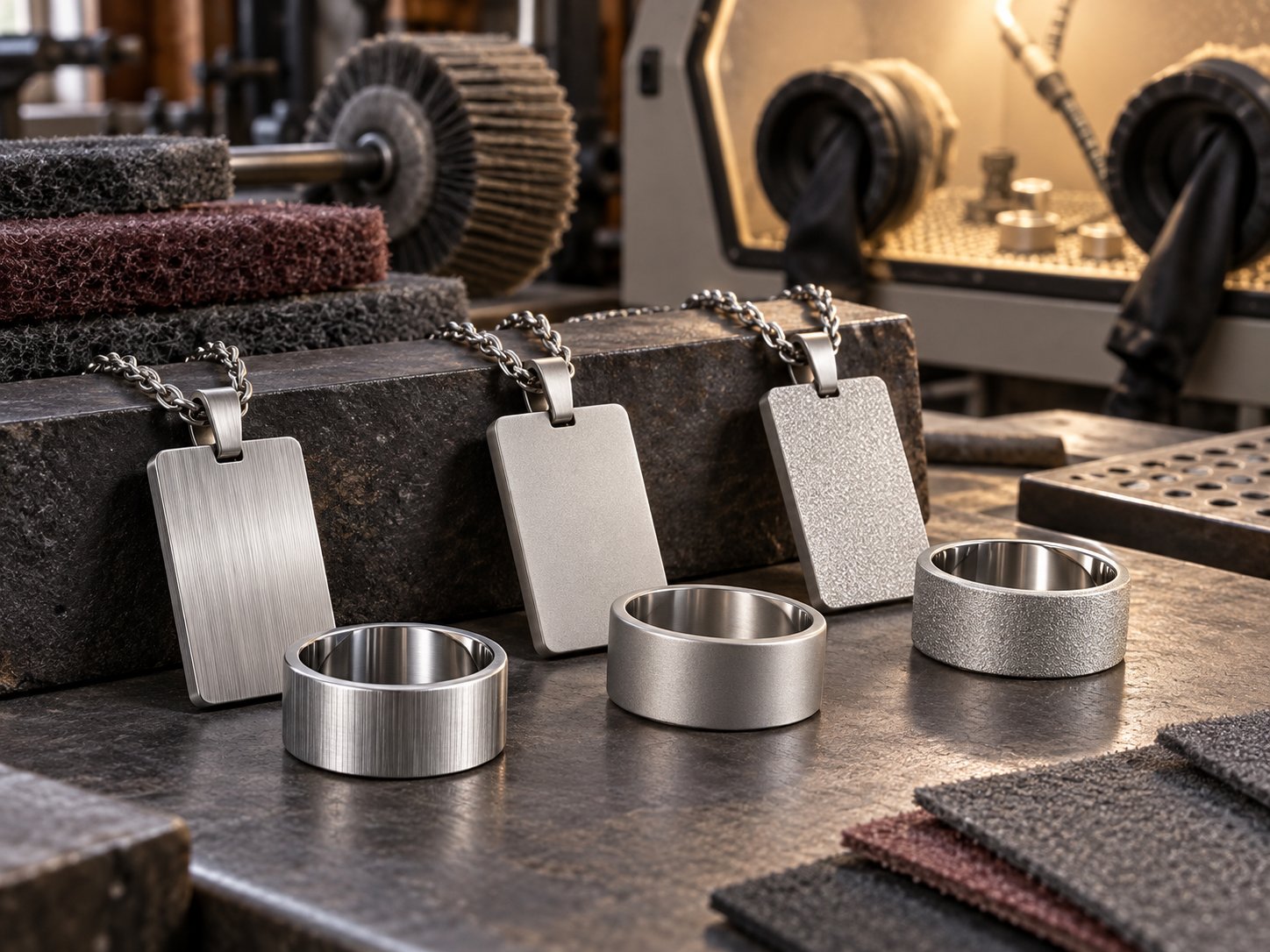
A poorly polished 316L piece performs worse in contact with skin than a well-polished 304 piece, because corrosion starts in surface defects. Grade and finish are not independent choices. If you are cutting cost, cut it in the grade of a component the customer does not touch, not in the polish of a piece they wear.
Next step
Have a project this applies to?
Keep reading
More buyer guides
How to evaluate a stainless steel jewelry supplier
Ten questions that separate a manufacturer from a middleman, and the answers that should worry you.
Launching a first stainless steel jewelry collection
What to develop first, what to defer, and how to keep the first order affordable.
What MOQ really means for custom jewelry
Why there is no single number, what drives it, and how to negotiate it sensibly.