OEM, ODM or private label?
The three words get used interchangeably in supplier marketing, but they describe three different divisions of work between you and the factory — and choosing the wrong one costs months.
Published 2026-10-28 · Reviewed by Felix, founder of KUBO Jewelry
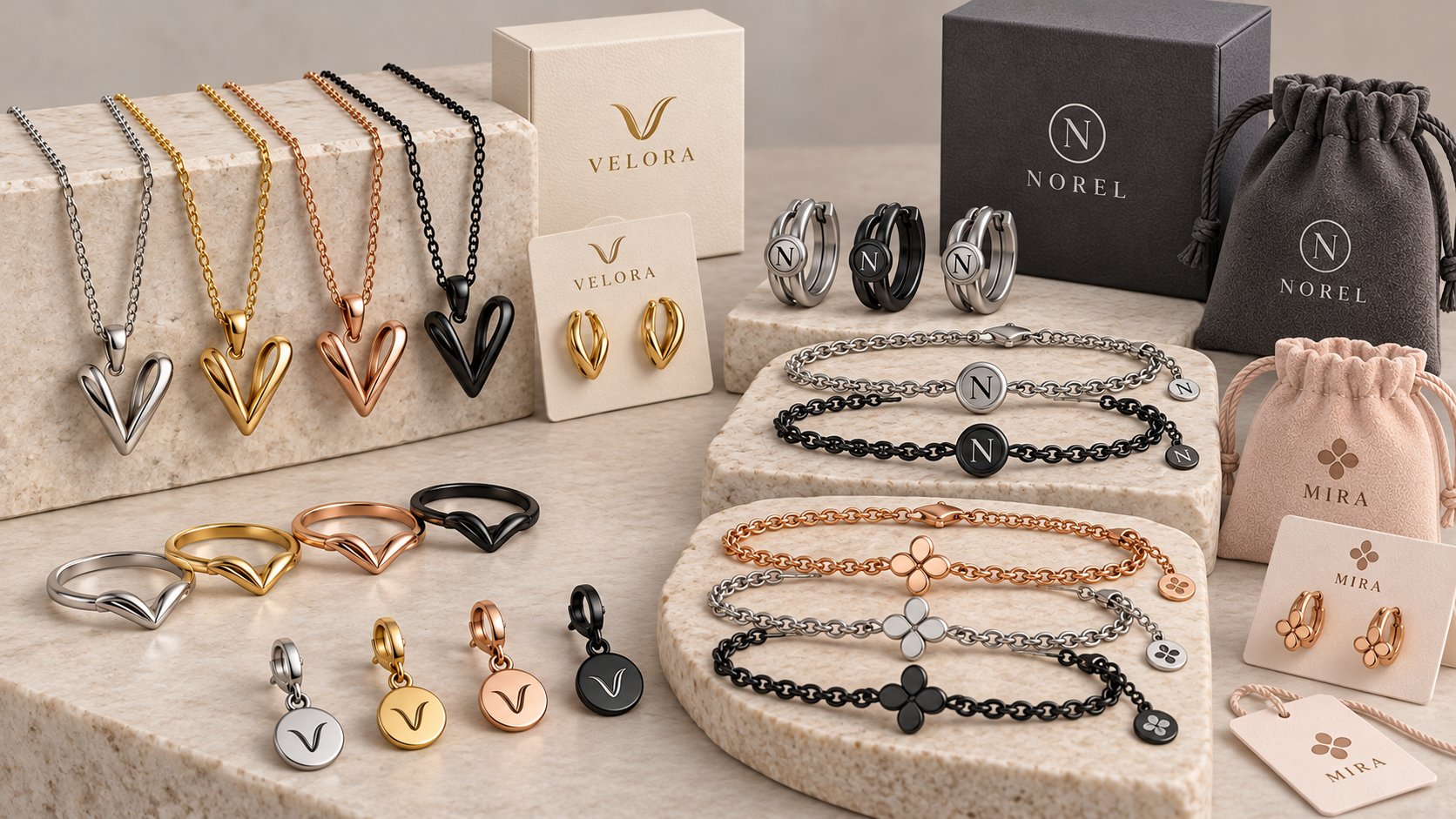
OEM means you supply the design and the factory manufactures it — tooling, engineering and production on your specification. ODM means you bring a direction and the factory contributes the design engineering — structure, materials, finish options — before you approve samples. Private label means the factory adapts existing proven styles with your branding, markings and packaging for the fastest route to a coherent range. The right model depends on how fixed your design is, not on how big you are.
Every manufacturer's website says OEM, ODM and private label. Few explain that the words describe whose problem the design is. That is the entire distinction, and it is worth getting right before you send an enquiry, because the model you ask for determines the quotation you get back — and asking for the wrong one is the most common reason first enquiries stall.
The one-line definitions
- OEM (Original Equipment Manufacturer). You own the design. The factory owns manufacturing. You supply drawings, a technical specification or an approved physical sample, and the factory builds to it.
- ODM (Original Design Manufacturer). You own the direction. The factory contributes design engineering — structure, material choice, finish options, production feasibility — and you approve samples before committing to volume.
- Private label. The factory owns a base of proven styles. Your brand gets its own dimensions, markings, logo application and packaging on those styles, producing a coherent range without a development phase.
The size of your company has nothing to do with the choice. A one-person label with a fixed design is running OEM. A national retailer with no fixed design is running ODM.
The three models against the questions that matter
| Question | OEM | ODM | Private label |
|---|---|---|---|
| Who owns the design? | you | shared, output yours | factory (base styles) |
| What you bring | drawings / spec / sample | direction, references, brand brief | logo, packaging, selections |
| Development time | longest | medium | shortest |
| Tooling | likely, cost on you | possible, scoped before sampling | usually none |
| Exclusivity | full, if agreed in writing | negotiable | base styles stay non-exclusive |
| Best for | established lines, protected designs | first collections, direction-led brands | speed to market, gifting, retail fill |
OEM: when you already know exactly what you want
OEM is the right model when your design is fixed — a CAD file, a dimensioned drawing, or a physical reference sample you have the right to reproduce. The factory's job is translation: turning your intent into a production plan, quoting tooling honestly, and building to the approved sample without improvisation.
What OEM demands from you is specification discipline. The most common OEM failure is not bad manufacturing — it is an incomplete spec. If thickness, weight, clasp type, chain gauge, finish and marking positions are not written down, the factory will fill the gaps with defaults, and you will discover those defaults on the pre-production sample, two weeks and one sampling round later.
What you should expect from a factory in OEM: a written production plan before tooling, a sample that matches the spec rather than "close to the reference", and a clear statement of what tooling you are paying for and who owns it. Tooling ownership should be in the contract — if you paid for the mould, the mould is yours, and that should be true when you move it to another factory.
ODM: when you have a direction but not a design
ODM fits the stage where most brands actually are: you know your market, your price point and your aesthetic, but you do not have production drawings, and you do not want to pay a freelance CAD designer to make drawings for a factory that would redraw them anyway.
In ODM, the factory's engineering input is the product. Material choice (304 vs 316L), structural decisions (hollow vs solid, soldered vs assembled), finish selection and gauge recommendations change both cost and durability — and a manufacturer who makes jewelry every day has better priors on those decisions than a design studio that does not.
What ODM demands from you is a brief with real constraints in it: target retail price, target weight where it matters, market and its compliance needs, and the finish palette of your range. What you should expect back is samples that vary — different gauges, different construction — rather than one sample of one interpretation. If an "ODM" supplier sends back a single sample and no engineering commentary, they are not doing ODM; they are doing private label with extra steps.
Private label: when speed and coherence beat novelty
Private label is the model people underestimate. The factory adapts styles that are already in production — known tooling, known cost, known quality behaviour — with your logo application, your card and box, your colour mix. There is no development phase to fail, no tooling to amortise, and the minimums are typically the lowest of the three models.
The trade-off is exclusivity: base styles are available to other buyers. Your brand layer — the curation, the marking, the packaging, the photography, the range logic — is the differentiation. That is not a weakness; it is how most successful jewelry retail brands actually operate. Very few customers ever see a competing product built on the same base style, because the brand layer is what they are buying.
Private label is also the pragmatic answer for specific commercial situations: corporate gifting, promotional campaigns, retail fill-in ranges, and testing a new market with a small, fast, low-commitment order.
The hybrid nobody names
In practice, most real programs are hybrids: a brand's hero pieces are OEM (developed, tooled, protected), its seasonal volume is ODM (direction-driven, fast sampling), and its entry-price or gifting layer is private label. This is a sensible structure, and it is worth deciding deliberately rather than drifting into it by what the supplier offers.
A typical first-year split we see work well:
- OEM for two to four signature pieces that define the brand.
- ODM for the seasonal range built around those signatures.
- Private label for components, gifting and fill — chains, basics, gift sets.
How to tell a factory which one you want
When you enquire, describe your stage in these terms instead of the acronym alone:
- "I have a CAD file and a spec — quote me manufacturing." (OEM)
- "I have a direction and a price point — show me engineering options and samples." (ODM)
- "I need a coherent range fast, with my marking and packaging — show me base styles." (Private label)
A factory that responds to all three of those enquiries with the same quotation template is telling you something. The models have different inputs, and the quote should show it: tooling lines in OEM, engineering and sampling structure in ODM, style-selection and branding options in private label.
Whichever model you run, two things should always be in writing before development starts: who owns the tooling, and what happens to the design if the relationship ends. Everything else in jewelry manufacturing is negotiable; those two are the ones that matter if things go wrong.
Next step
Have a project this applies to?
Keep reading
More buyer guides
PVD vs electroplating for jewelry
Why the two finishes behave differently on skin, and why we coat everything by PVD instead of plating it.
Stainless steel vs brass vs zinc alloy for jewelry
The three metals behind most mass-market jewelry lines, compared on what actually matters — cost behaviour, weight, allergy risk and how long a colour survives.
Launching a first stainless steel jewelry collection
What to develop first, what to defer, and how to keep the first order affordable.