What custom jewelry actually costs.
Most factories will not put a number in writing until you send a design. That is reasonable, but it leaves buyers with no way to budget. These are the ranges we quote, and the four variables that move a piece from one end to the other.
Published 2026-10-29 · Reviewed by Felix, founder of KUBO Jewelry
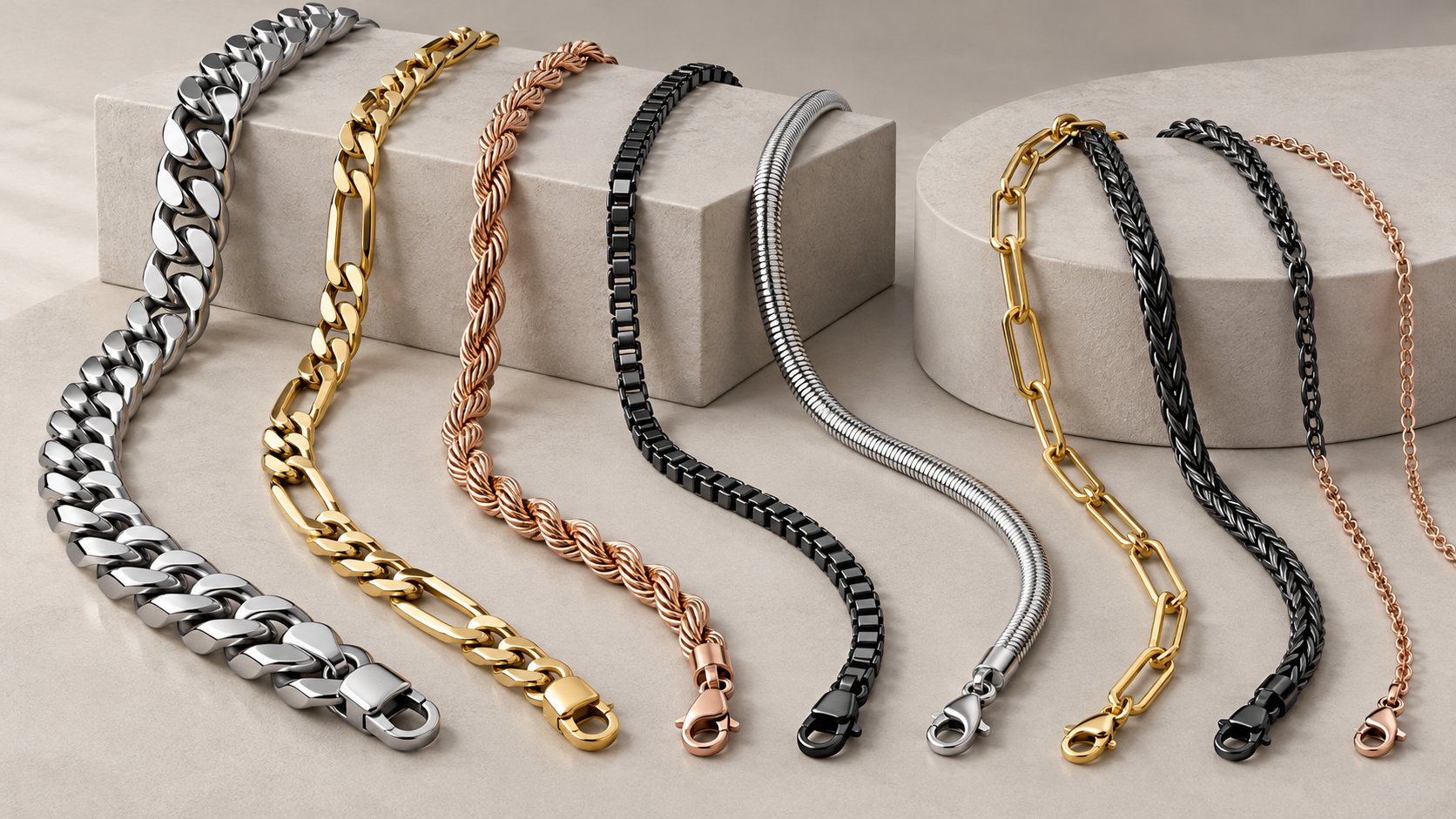
Custom stainless steel jewelry from a Guangzhou factory typically lands between US$0.80 and US$5.00 per piece at production volume. The range is not a markup range — it is the spread between a 2 mm laser-cut charm and a 10 mm cast signet ring with PVD coating and laser engraving. Within that band, the four things that move price most are metal volume, construction method, finish, and order quantity.
Asking a factory "how much for a ring" is like asking a printer "how much for a poster". The honest answer is a range wide enough to be useless, and the reason most factories deflect the question is that a number given without a design is a number they will have to walk back later.
This is the version of the answer we give buyers who ask directly: a real per-piece band, and the four variables that decide where inside that band your design lands.
The band: US$0.80 to US$5.00 per piece
For stainless steel jewelry produced at commercial volume — roughly 300 pieces per design and up — most designs we quote fall between US$0.80 and US$5.00 per piece, ex-works Guangzhou.
That is the delivered-to-your-warehouse price before freight, duty and your own packaging. It is not a retail range and it is not a "from" price used as bait; the low end and the high end are both real pieces we produce regularly.
| What sits at the low end | What sits at the high end |
|---|---|
| Laser-cut flat charm, 1 mm stock | Cast signet ring, 8–10 mm face |
| Simple 2 mm curb chain, 45 cm | Heavy 8 mm Cuban link, 55 cm |
| Stamped pendant, single-side engrave | Two-piece construction, PVD + laser engrave |
| Plain push-back stud earring | Hinged hoop with stone-set detail |
The gap between those two columns is roughly six times. Nothing about the metal explains that gap on its own — both are 304 or 316L from the same shelf.
Variable one: metal volume
Steel is cheap. The labour attached to steel is not.
A 3 mm flat band and a 6 mm comfort-fit band use different amounts of metal, but the cost difference comes mostly from polishing time, not from material. Every extra square millimetre of surface has to be cut, deburred and polished by hand or in a barrel, and polishing is the single largest labour line in most stainless steel pieces.
This is why weight is a better predictor of price than size. A hollow-looking 20 mm pendant can cost less than a solid 6 mm ring.
Variable two: construction
There are three broad routes, and they price very differently:
- Laser cutting from sheet. No mould. Lowest tooling, fastest setup, lowest unit cost. Best for flat charms, tags and plates.
- Stamping. A die is cut, then pieces are punched. Mid tooling cost, very low unit cost at volume, and the die is reusable across orders.
- Casting. A mould is cut, then pieces are cast. Highest tooling, highest unit cost at low volume, but the only route to genuine three-dimensional form.
A design that can be made by laser cutting instead of casting often halves its unit cost. That is a design decision, not a sourcing decision, and it is worth having before you brief a factory.
Variable three: finish
Every colour we supply is PVD, applied in-house — we do not run an electroplating line. PVD is a vacuum process that bonds the colour layer into the steel rather than sitting it on top, and it costs more per batch than conventional plating because the chamber load is the unit of work, not the piece. That premium is what buys a finish that survives sweat and swimming.
Two practical consequences for your budget:
Finish colour is not free, and it is not per colour. A batch is a batch whether it is one colour or four, so a four-colour launch is not four times the finishing cost — but it is four separate chamber runs, which is why colour count still matters at low volume.
Hand finishing is a separate line. Mirror polish, brushed, satin, hammered and sandblasted are different sequences of the same work, and a hammered surface costs more than a mirror surface on a flat piece because it is done by hand.
Laser engraving is priced per piece and per pass. One side, shallow, is cheap. Both sides, deep, with a filled area, is not.
Variable four: quantity
This is the variable buyers most often misjudge, and the one where a factory's answer is genuinely informative.
Setup — programming, die or mould checks, first-article inspection, colour matching — is a fixed cost per order. Spread across 300 pieces it is visible in the unit price. Spread across 3,000 it is almost gone.
The practical effect: a design quoted at 300 pieces and the same design at 3,000 pieces are not the same product economically, and a supplier who quotes you one number without asking your quantity is guessing.
What is not in the unit price
Four things routinely surprise first-time buyers, all of them legitimate and all of them quotable in advance:
Sample fee. Depends on the design and the quantity. For buyers who place repeat orders, and where the sampling cost is low, we generally sample free of charge — but a complex piece with custom tooling is a real cost and we will say so at the brief stage rather than bury it in the unit price.
Tooling. Dies and moulds are a one-off charge, and they are yours. Ask who holds them if you change supplier — the answer should be you.
Compliance testing. If your market requires a nickel release test or a REACH statement, that is a laboratory cost, quoted separately and agreed before it is incurred. We will not add it silently to a unit price.
Packaging. Unbranded OPP bags are free. Branded boxes, printed cards and full retail sets depend entirely on your specification and are quoted separately.
How to get a number you can budget with
Send four things and you will get a real figure rather than a range:
- A design reference — a photo, a sketch, or a link to a similar product.
- Material — 304 or 316L. If you do not know, say what the piece touches: 316L for anything worn against skin daily.
- Finish and marking — colour, surface, and whether there is a logo.
- Quantity — the quantity you actually intend to order, not a number you think sounds respectable.
With those four, a quotation is arithmetic. Without them, it is a guess dressed as a price, and the guess usually favours the buyer at quotation stage and the factory at delivery stage.
The honest position on very small orders
Below roughly 100 pieces per design, the arithmetic stops working — not because of margin, but because setup cost per piece becomes larger than the piece. We would rather tell you that than quote a number that makes a 100-piece order look viable and then deliver something that does not match the sample.
If you are pre-launch and testing a design, the sensible route is a proven base style adapted with your branding, and a conversation about which one.
Next step
Have a project this applies to?
Keep reading
More buyer guides
OEM vs ODM vs private label for jewelry brands
What the three manufacturing models actually mean, what you supply in each, and how to pick the one that fits your stage.
PVD vs electroplating for jewelry
Why the two finishes behave differently on skin, and why we coat everything by PVD instead of plating it.
Stainless steel vs brass vs zinc alloy for jewelry
The three metals behind most mass-market jewelry lines, compared on what actually matters — cost behaviour, weight, allergy risk and how long a colour survives.