Plating & finishing.
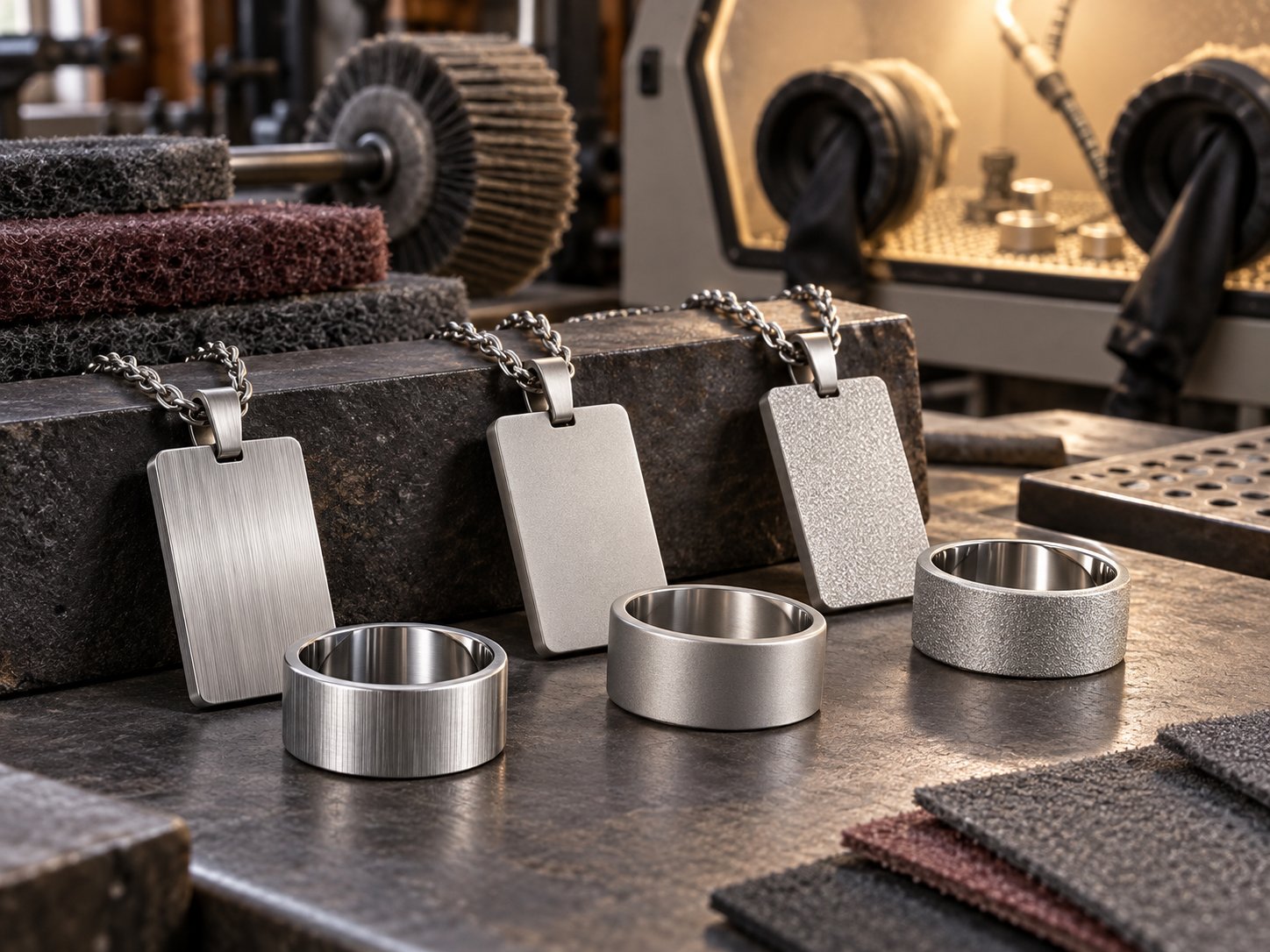
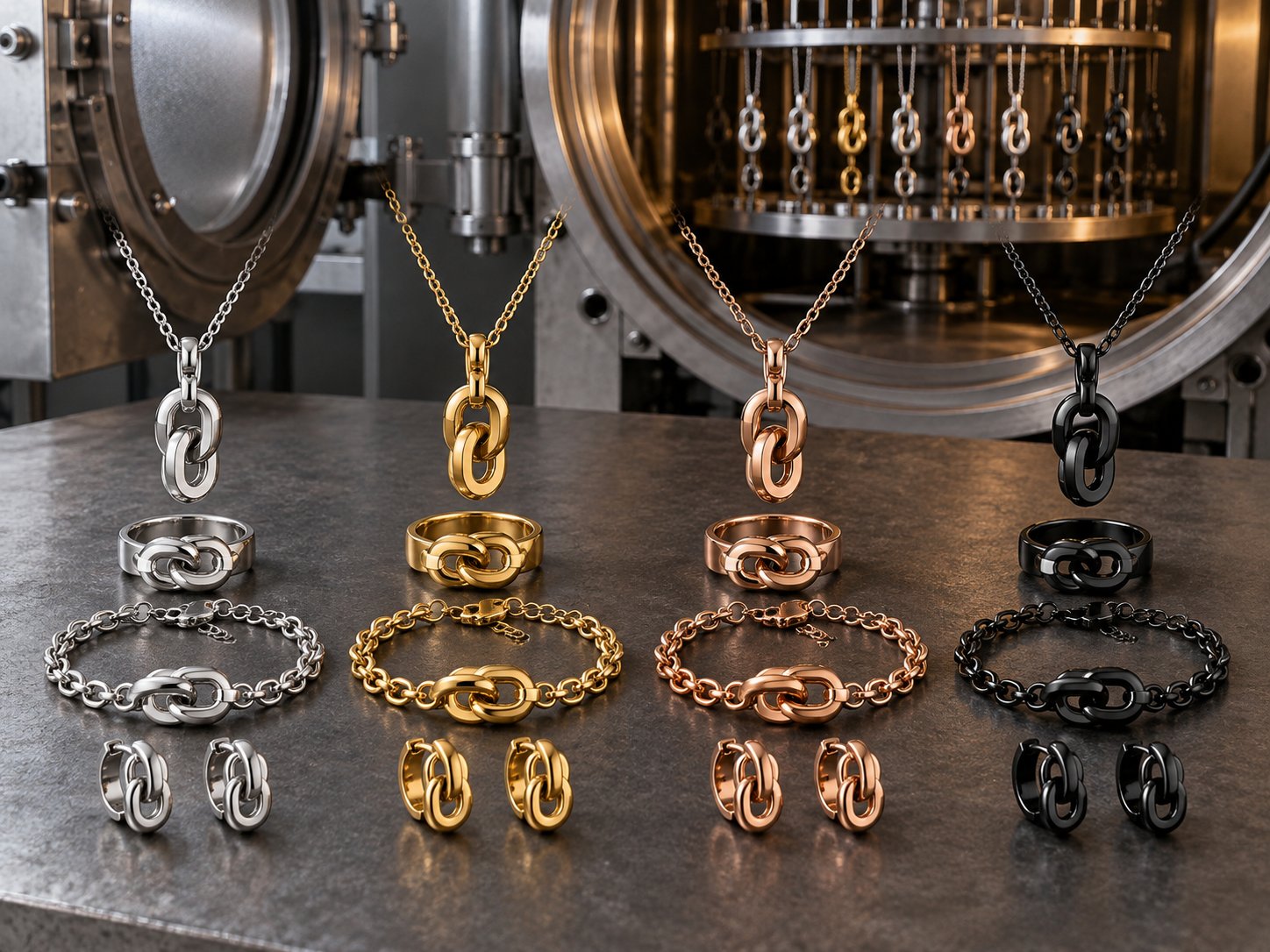
Surface is what the customer sees first and judges longest. Mirror, brushed and satin polishing, plus PVD colour coating in gold, black, gunmetal and champagne.
Reviewed 19 October 2026
KUBO Jewelry offers stainless steel surface finishing including mirror polish, brushed, satin and sandblasted finishes, PVD colour coating in gold, rose gold, black, gunmetal, champagne and blue, and hand-applied enamel colour filling for recessed designs. PVD is a vacuum deposition process rather than electroplating, giving a harder colour layer that resists tarnishing and wear.
Finish is where a stainless steel piece earns or loses its price. The same casting in mirror polish and in a thin electroplated colour are two different products at two different price points, and the difference is visible across a room.
Polishing
Mirror polish reflects like chrome. It is the most expensive finish in labour terms because every surface must be brought to the same level — a single flat spot or polishing line shows immediately under direct light. It also shows fingerprints, which matters for retail display and for e-commerce photography.
Brushed and satin finishes carry a directional grain. They hide handling marks, photograph well under soft light, and are more forgiving in transit. For most mid-market collections, satin is the better commercial choice even where mirror looks stronger in a sample photo.
Sandblasted and matte finishes give a soft, non-reflective surface. They are less common in stainless steel than in precious metals, and work well for architectural or minimal designs.
Finish combinations are possible and often worthwhile: a polished face with a brushed side reads as more considered than either finish alone.
PVD, and why it matters
PVD — physical vapour deposition — is not electroplating. The colour layer is deposited in a vacuum as a thin film that bonds at the molecular level, and it is substantially harder than an electroplated layer of the same thickness.
Practically, that means:
- Better colour retention. A gold PVD piece will not lose tone at the high points the way a plated piece does after a few months of wear.
- No nickel in the colour layer itself. PVD deposits a ceramic-metal film, not a nickel-bearing electroplated layer — which matters for EU nickel release requirements on the coated surface. It does not make the steel underneath nickel-free, and the release test is still on the finished piece.
- Thickness matters. PVD at 0.3 µm and at 1 µm are not the same product. Ask what thickness is being quoted, because it is the variable that determines how long the colour survives.
Available colours: gold, rose gold, black, gunmetal, champagne, blue. Colour matching between batches is close but not absolute, which is why we retain a reference piece from each approved run.
Enamel colour filling
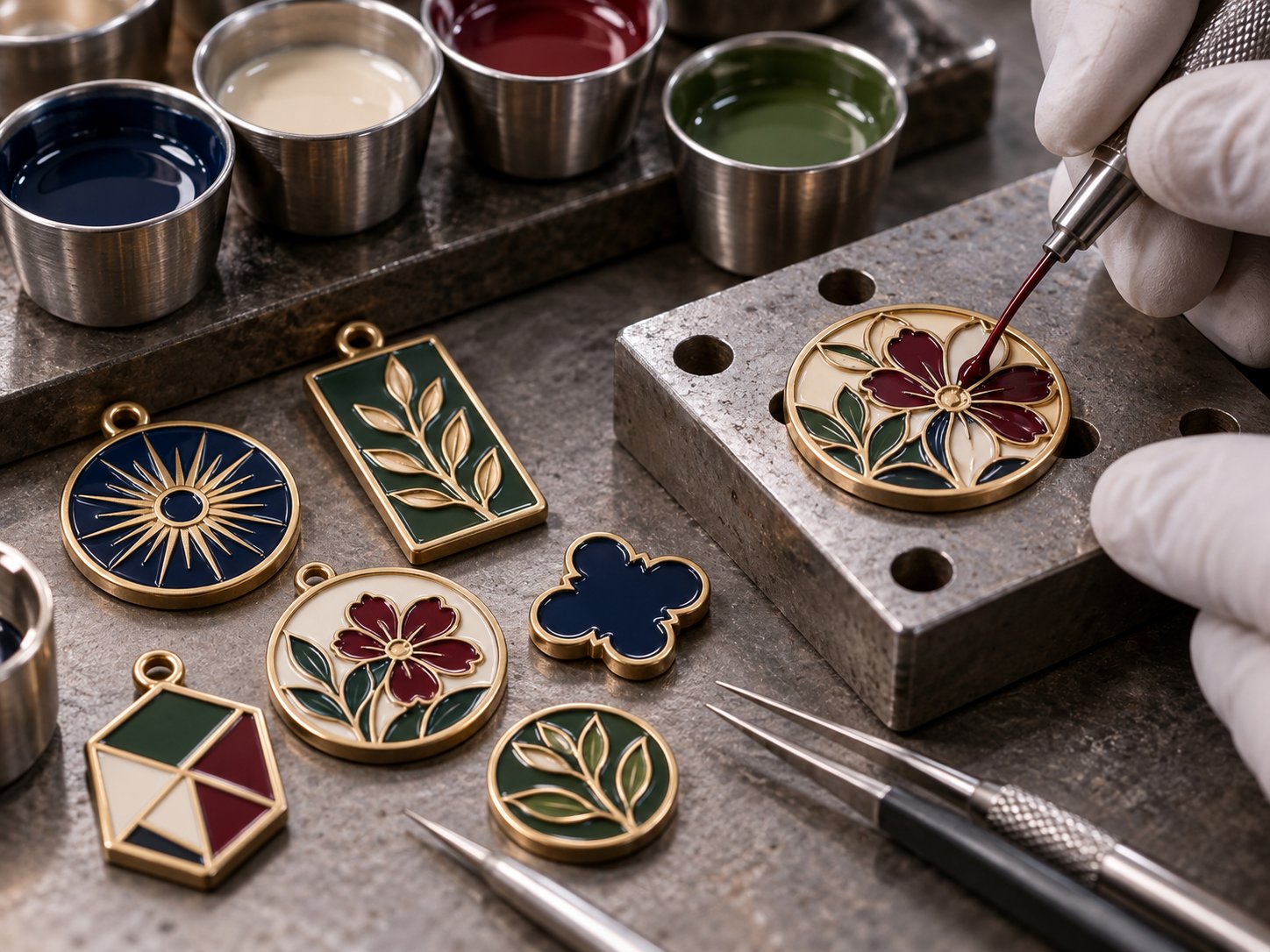
Enamel filling is a hand-applied colour process for recessed designs: the cavities are filled with liquid enamel, levelled, cured and polished back so the colour sits flush with the surrounding metal. It suits logos, botanical and geometric patterns, and pieces where a printed or engraved mark would be too subtle.
The practical limits are worth knowing before you design:
- Colour matching is by eye against a physical sample. Enamel pigments do not carry Pantone references; the approved sample is the colour standard for the run.
- Fine detail needs wall definition. Recesses narrower than roughly 0.5 mm do not fill cleanly, so very fine line work is better done by laser engraving.
- Hand application means per-piece variation. Small differences between pieces are inherent to the process; if absolute uniformity matters, PVD or engraving is the better route.
What we tell buyers about durability
Honest limits, because they matter for how you describe the product:
- PVD will not survive sustained abrasion against hard surfaces. Sand, concrete and keys will wear through it.
- Chlorinated water dulls coloured finishes over time. Bare steel is unaffected.
- Thin PVD over a poorly polished surface inherits the faults underneath. Polish quality and coating quality are not separable.
If a product page says "waterproof, never fades", it is overstating. What is defensible is "water-resistant, tarnish-resistant, and colour-coated with PVD for wear resistance".
Also in capabilities
The rest of the sequence
Each stage is handled by the same team, so the specification that leaves your brief arrives intact at the production line.
Engineering & sampling
Specification, tooling and physical samples approved before any bulk commitment.
03Logo & packaging
Engraving methods, brand marks and packaging that survive the unboxing photograph.
04Quality control
In-line inspection at casting, polishing, plating and packing — with a written record.
05Export & logistics
Export documentation, shipping terms and delivery worldwide.
Questions about this stage?
Ask before you commit.
Technical questions are answered by the people who will run your production, not by a sales script.
Ask a technical question →