Engineering & sampling.
A collection is decided here. Material grade, section, weight, tolerances and finish are fixed in a written specification and proven with a physical sample before a single bulk unit is made.
Reviewed 19 October 2026
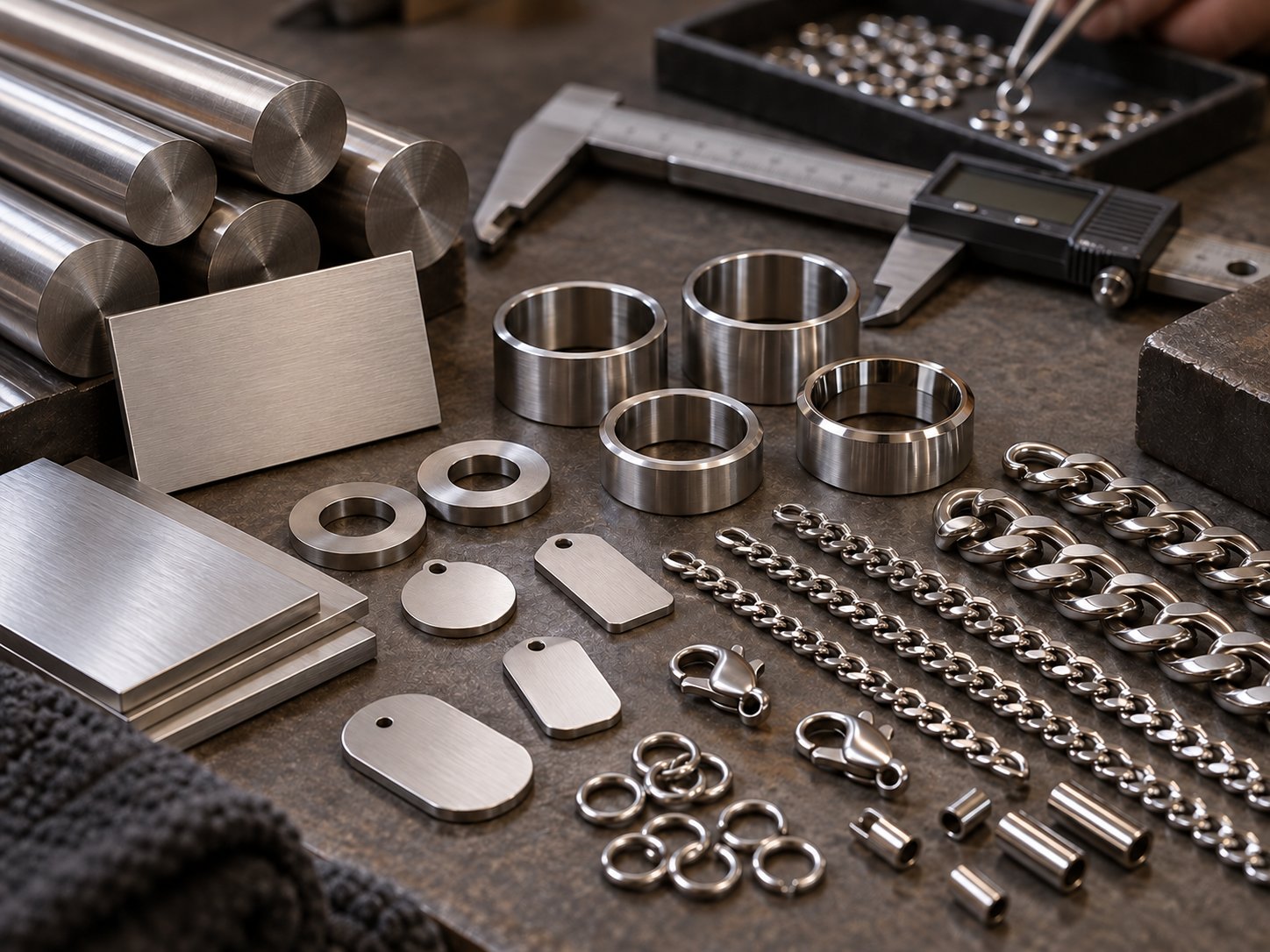
KUBO Jewelry develops a written specification for every custom stainless steel jewelry project — material grade, dimensions, wall thickness, weight, tolerances, finish and branding method — and produces a physical sample for approval before bulk production. Sampling typically takes 10–15 days after specification approval, longer where new tooling is required.
Most failed projects do not fail in production. They fail at the brief, when a design is agreed in a photograph and a price is quoted against assumptions nobody wrote down.
What a specification contains
We put seven things in writing before sampling starts:
- Material grade — 304 or 316L, and which parts use which.
- Dimensions — outer size, width, thickness, and tolerances on each.
- Wall thickness — critical on hollow and formed pieces, and the most common source of disagreement later.
- Target weight — with an acceptable range, since weight and perceived value are linked.
- Surface finish — polish grade, brushed direction, or colour coating specification.
- Branding method — engrave depth, placement and finish.
- Assembly — clasp type, jump ring gauge, chain matching.
A buyer who receives a quote without those seven points is comparing prices for products that do not yet exist.
Tooling
Tooling falls into three broad cases:
- No tooling — laser-cut flat pieces, standard chain assemblies, adaptations of an existing base shape.
- Simple tooling — a stamping die or a single mould for a cast piece. Cost is usually modest and amortised against the first order.
- Complex tooling — multi-part moulds for sculpted or articulated pieces. This is where tooling cost becomes a genuine decision point, and where it is worth asking whether a simplified design achieves the same commercial result.
Tooling ownership should be agreed in writing. Our position is straightforward: tooling paid for by a client belongs to that client for the life of the relationship, and we do not use it for another buyer.
Sampling
Sampling typically takes 10–15 days after the specification is approved. New tooling extends that. We send photographs at each stage and ship the physical sample with a written record of the specification it was made against, so an approval refers to a document rather than to a memory.
Revision rounds are expected — most designs need one or two. What we try to avoid is a revision round that exists because a decision was deferred at the brief stage. Those are the expensive ones.
The approval that matters
A sample approval is the point at which responsibility for the specification passes to us. Before that point, changes are design discussion. After it, the bulk order will be produced to match the approved piece exactly — including any decisions made by omission.
Also in capabilities
The rest of the sequence
Each stage is handled by the same team, so the specification that leaves your brief arrives intact at the production line.
Plating & finishing
Mirror, brushed, satin and PVD colour coating — specified, not improvised.
03Logo & packaging
Engraving methods, brand marks and packaging that survive the unboxing photograph.
04Quality control
In-line inspection at casting, polishing, plating and packing — with a written record.
05Export & logistics
Export documentation, shipping terms and delivery worldwide.
Questions about this stage?
Ask before you commit.
Technical questions are answered by the people who will run your production, not by a sales script.
Ask a technical question →